Types of Goldfish: 14 Popular Breeds With Pictures, Care & Tank Size Guide
By Giovanni Carlo · Fish keeper & founder, Giobel Koi Center · Updated June 8, 2026

Quick Answer
There are over 200 recognized goldfish varieties worldwide, but they fall into two main groups: single-tailed goldfish (Common, Comet, Shubunkin — hardy, fast, pond-suited) and fancy goldfish (Ranchu, Oranda, Fantail, Ryukin, Black Moor, Bubble Eye, and more — rounded bodies, double tails, require more care). The most important rule: never mix the two groups in the same tank.
In This Guide
- Single-Tailed vs. Fancy: The Most Important Distinction
- Single-Tailed Goldfish (Hardy Varieties)
- Fancy Goldfish (Double-Tailed Varieties)
- All 14 Types at a Glance — Quick Comparison
- How to Choose the Right Goldfish for You
- Goldfish Care Basics Every Owner Needs to Know
- 3 Common Mistakes New Goldfish Owners Make
- Frequently Asked Questions
Single-Tailed vs. Fancy: The Most Important Distinction
Before choosing a goldfish, there is one distinction you must understand — it will determine your tank setup, your choice of tank mates, and how much care your fish will need. All goldfish fall into one of two fundamental groups:
Single-Tailed Goldfish
- Streamlined, elongated body
- One tail fin
- Fast, powerful swimmers
- Very hardy — beginner friendly
- Best in outdoor ponds
- Grow large (12–14 inches+)
Fancy Goldfish
- Round, egg-shaped or humped body
- Double tail fin
- Slow, graceful swimmers
- More delicate — intermediate care
- Best in aquariums
- Typically 6–10 inches
Critical Rule
Never mix single-tailed and fancy goldfish in the same tank or pond. Single-tailed varieties are faster and far more aggressive feeders. They will consistently outcompete fancy varieties for food, leaving your fancy fish underfed, stressed, and vulnerable to disease. Always keep the two groups in separate setups.
Single-Tailed Goldfish: Hardy, Pond-Ready Varieties
Single-tailed goldfish are closest to their wild carp ancestors — streamlined, fast, and tough. They are the right choice for outdoor ponds, beginners, and anyone who wants a low-maintenance fish that can thrive with minimal intervention.
1. Common Goldfish
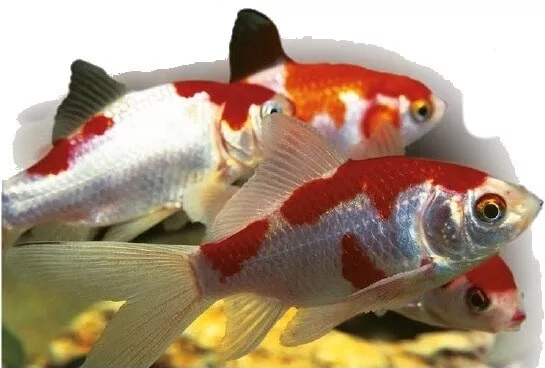
The Common Goldfish is the original — the fish from which every other goldfish variety was selectively bred over the past 1,000 years in China. It has a streamlined body, a single tail, and comes in orange, red, yellow, white, and red-and-white. This is the goldfish most people picture when they hear the word “goldfish.”
Common goldfish are extremely hardy and can tolerate a wide range of water temperatures, including freezing pond winters where they enter a semi-dormant state. They grow large — up to 14 inches in a proper pond — and can live 20 years or more with good care. They are best kept in outdoor ponds rather than tanks, where they have room to grow and thrive.
2. Comet Goldfish (Long-Tail)
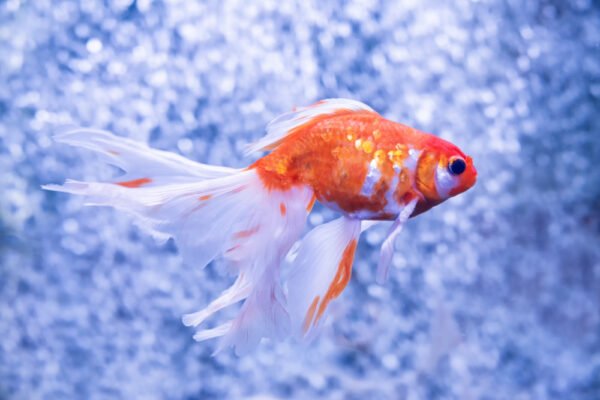
The Comet is an American development of the Common Goldfish, first bred in Washington D.C. in the 1880s. Its defining feature is a long, deeply forked single tail fin that can equal or exceed the body length — giving it a flowing, comet-like appearance in motion. Comets are active, energetic swimmers and among the fastest of all goldfish.
Like the Common Goldfish, Comets are highly hardy and best suited to outdoor ponds. They come in a range of colors including red, orange, yellow, white, and the popular Sarasa pattern (white with red markings). If you want an active, visually striking pond fish that requires minimal intervention, the Comet is an excellent choice.
3. Shubunkin Goldfish
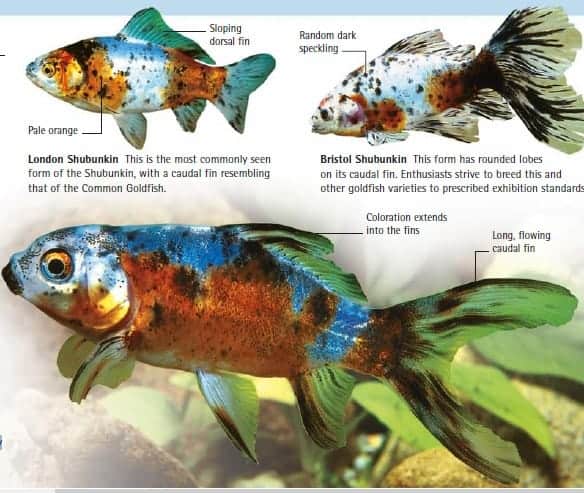
Shubunkin are sometimes called “calico goldfish” — and the name fits. They have a nacreous (semi-transparent, pearly) scale type that produces a uniquely mottled pattern of blue, red, orange, black, and white. The blue coloration is especially prized — a Shubunkin with a strong blue base is considered high quality.
There are three sub-types: the London Shubunkin (rounder tail), the Bristol Shubunkin (large, heart-shaped tail), and the American Shubunkin (deeply forked tail similar to a Comet). All are equally hardy and pond-ready. Shubunkin are popular for larger outdoor ponds because their multi-color pattern is highly visible from above.
Fancy Goldfish: Double-Tailed Varieties
Fancy goldfish are the product of centuries of selective breeding for ornamental beauty. Their rounded bodies, flowing double tails, and extraordinary features — head growths, telescope eyes, fluid-filled sacs — make them living works of art. They require more attention than single-tailed varieties but reward careful keepers with extraordinary beauty.
4. Fantail Goldfish
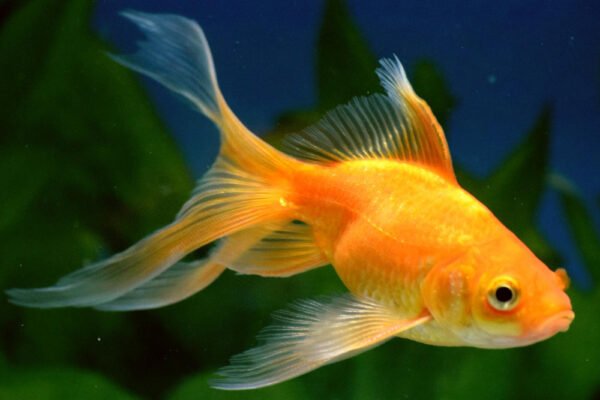
The Fantail is widely considered the best entry-level fancy goldfish — the bridge between the hardy single-tailed varieties and the more delicate fancy types. It has the classic egg-shaped body of fancy goldfish, a high dorsal fin, and a flowing double tail that fans out beautifully as the fish moves. Fantails come in a wide range of colors including red, orange, calico, and red-and-white.
Compared to other fancy varieties, Fantails are relatively robust. They tolerate a wider range of water temperatures and are less prone to the swim bladder issues that affect more extreme fancy breeds. A minimum 20-gallon aquarium is needed for one Fantail, with 10 extra gallons for each additional fish.
5. Ryukin Goldfish

The Ryukin is a Japanese fancy goldfish with a very distinctive profile — a sharply pronounced hump or dorsal arch behind the head that gives the fish a deep, triangular body shape. This hump is one of the Ryukin’s defining quality markers: the sharper and more prominent the hump, the more highly valued the fish. Ryukin come in red, white, red-and-white, calico, and tri-color.
Originally called Nagasaki goldfish or Onaga (longtail) goldfish when they arrived in Japan in the early 1800s, Ryukin were introduced via the Ryukyu Islands (modern Okinawa) — hence the name. They are active, competitive feeders and can sometimes be aggressive toward slower tank mates. Best kept with other Ryukin or similarly sized and active fancy varieties.
6. Oranda Goldfish
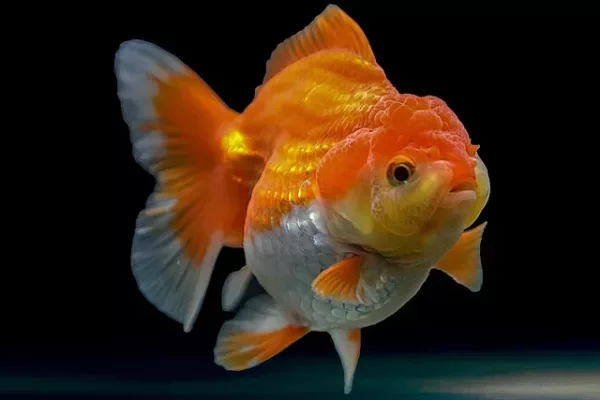
The Oranda is one of the most popular fancy goldfish in the world — and its defining feature is the wen, a fleshy, raspberry-textured head growth that covers the top and sides of the head and can extend around the entire face on mature specimens. The wen develops slowly as the fish ages, becoming more prominent and dramatic over the fish’s lifetime.
Oranda come in a remarkable range of colors and varieties: the Red Cap Oranda (white body, red wen only), standard red, calico, black, chocolate, and blue. The wen requires periodic attention — in some fish it can grow over the eyes, requiring trimming to maintain vision. Oranda are hardy for a fancy variety but sensitive to cold temperatures, which can cause the wen to become infected.
7. Koi-Pattern Goldfish
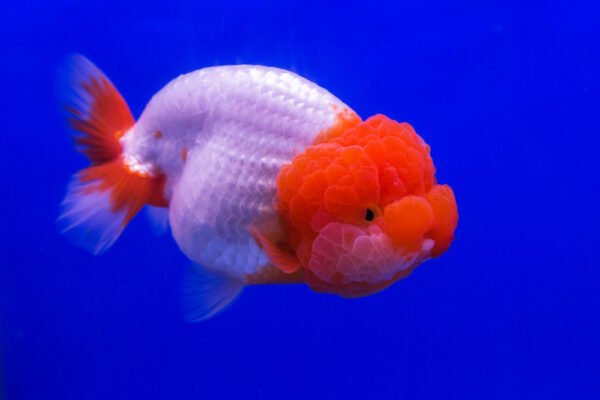
Some fancy goldfish — particularly certain Oranda and Ryukin varieties — are selectively bred to display bold, koi-like patterns of red, white, and black, making them visually indistinguishable from small koi at a glance. These are not a separate species but rather a color variety prized for their striking contrast and bold pattern definition.
They combine the ornamental drama of koi patterning with the compact size and aquarium suitability of fancy goldfish. For hobbyists who admire koi but lack space for a pond, these koi-patterned fancy goldfish offer a compelling alternative.
8. Black Moor Goldfish
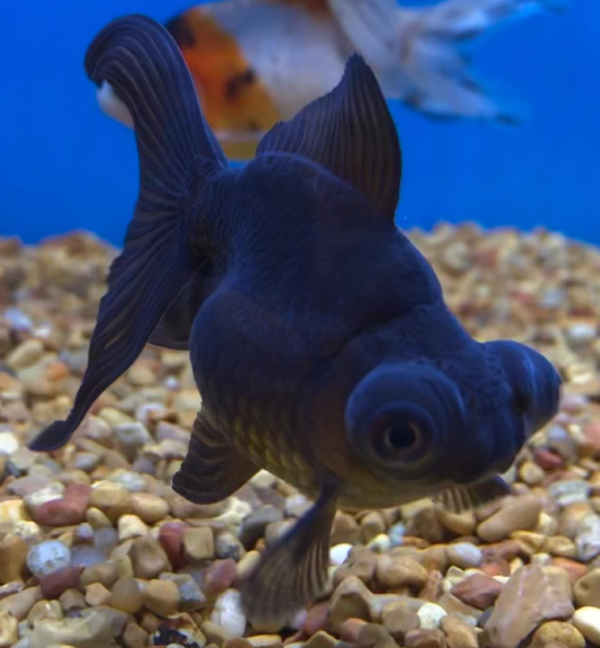
The Black Moor is one of the most immediately recognizable fancy goldfish — deep velvety black all over, with large, protruding telescope eyes that extend outward from the head. It is actually a black variation of the Telescope Eye (or Dragon Eye) goldfish. The black coloration is most intense on young fish and can shift toward bronze or orange in older specimens.
Because of their protruding eyes, Black Moors have limited vision and are poor competitors for food. They should be kept with other slow, non-aggressive fancy varieties. Avoid sharp tank decorations and ensure their food sinks to where they can find it. They are one of the most popular fancy goldfish for beginners because of their striking appearance and slightly more forgiving temperament compared to other telescope-eye varieties.
9. Ranchu Goldfish
The Ranchu (hero image above) is featured at the top of this post — regarded as the “king of goldfish” in Japan.
Known in Japan as the “King of Goldfish,” the Ranchu is a highly refined fancy variety developed through centuries of Japanese selective breeding. Its most striking feature is the complete absence of a dorsal fin — the back is smoothly curved from head to tail — combined with a deeply rounded, egg-shaped body and a prominent head growth (wen) similar to the Oranda’s. The tail turns sharply downward at the caudal peduncle, creating the characteristic “turned-down” tail.
Ranchu are judged at competitions where they are viewed from above — a perspective that reveals the symmetry and depth of the body shape that defines quality in this variety. They come in red, white, red-and-white, calico, and black. Ranchu are sensitive to poor water quality and temperature fluctuations; they require consistent care and excellent filtration.
10. Lionhead Goldfish
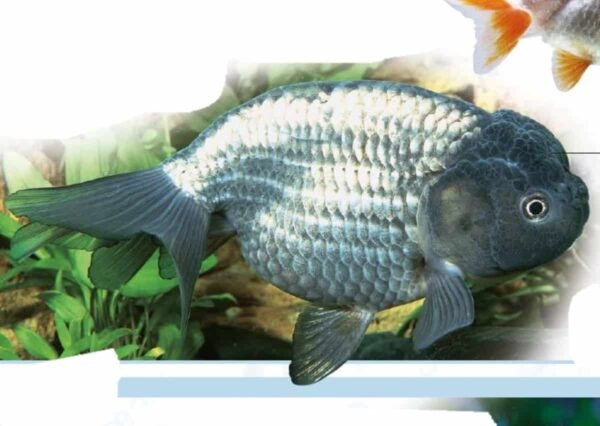
The Lionhead is the Chinese counterpart to Japan’s Ranchu — and the relationship between the two breeds is a point of genuine debate among goldfish enthusiasts. Like the Ranchu, the Lionhead has no dorsal fin and features a large, lumpy wen that covers the top of the head and often extends down the cheeks and gill covers, giving the fish a lion-like mane appearance.
The key difference from the Ranchu is in the back profile: Ranchu have an arched, curved back, while Lionhead backs are comparatively flatter. Lionheads also tend to swim in a more upright, less waddle-like manner. They are among the more fragile fancy varieties — the large wen can be prone to bacterial infection if water quality lapses.
11. Panda Moor Goldfish

The Panda Moor is a rare and striking variety of the Telescope Eye goldfish, selectively bred for a precise black-and-white coloring that mirrors the pattern of a giant panda — black patches around the telescope eyes, black fins, and a white body. Finding a high-quality Panda Moor with crisp, well-defined color boundaries and symmetric eye placement is genuinely rare.
Like all telescope-eye varieties, Panda Moors have limited vision due to their protruding eyes, are slow swimmers, and need careful tank management — no sharp objects, sinking food, and peaceful tank mates only. The black coloration can shift or fade as the fish ages, which is considered a natural characteristic rather than a flaw.
12. Bubble Eye Goldfish
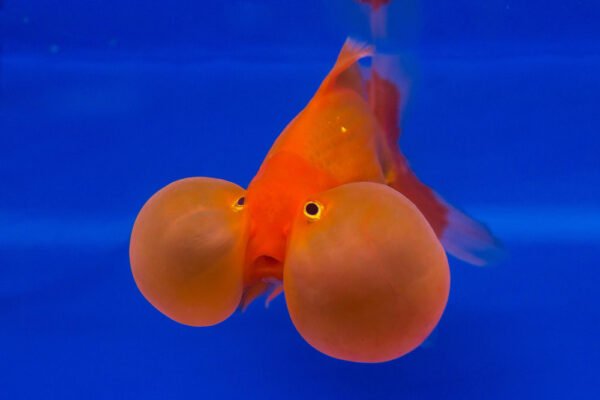
The Bubble Eye is one of the most unusual freshwater fish in the aquarium hobby. It has two large, fluid-filled sacs beneath its upward-pointing eyes — these sacs wobble dramatically as the fish swims and can grow to equal the size of the fish’s body in mature specimens. The fish also lacks a dorsal fin.
Bubble Eyes require specialized care: the sacs are extremely fragile and will rupture if the fish bumps a sharp object or gets caught in a filter intake. A sponge filter (rather than a standard intake) is essential. All tank decor must be smooth and rounded. Bubble Eyes should only be kept with other Bubble Eyes or similarly slow, delicate varieties. Despite the care requirements, they are among the most fascinating goldfish you can keep.
13. Pearlscale Goldfish

The Pearlscale is immediately identifiable by its extraordinary scales — each scale is dome-shaped and raised, with a calcium-white center that gives it the appearance of a pearl embedded in the skin. The effect across the entire body creates a texture unlike any other fish in the aquarium hobby. Combined with the Pearlscale’s nearly perfectly round body shape — sometimes compared to a golf ball — it is one of the most visually distinct goldfish varieties.
If a Pearlscale loses a scale (through injury or disease), the replacement scale that grows back is flat rather than dome-shaped — so maintaining good water quality and avoiding abrasive surfaces is important to preserve the fish’s appearance. The Crown Pearlscale (Hi Cap Pearlscale) adds a fluid-filled head growth similar to the Bubble Eye’s sacs, perched on top of the head like a crown.
14. Crown Pearlscale Goldfish

The Crown Pearlscale — also called the Hi Cap Pearlscale or Hamanishiki — is a Pearlscale goldfish with the addition of a fluid-filled growth on top of the head, sitting like a crown. This growth is similar in nature to the Bubble Eye’s sacs: filled with a clear, gelatinous fluid and prone to rupture if mishandled. When intact, it gives the fish a regal, extraordinary appearance.
Crown Pearlscale are among the rarest goldfish to find in Western markets. They combine the demanding care requirements of both the Pearlscale (pearl scales that don’t grow back correctly if damaged) and a fluid sac that must be protected. For experienced hobbyists who want one of the most unusual goldfish available, the Crown Pearlscale is a rewarding challenge.
All 14 Types at a Glance — Quick Comparison
| Variety | Group | Care | Max Size | Tank / Pond |
|---|---|---|---|---|
| Common | Single-tail | Beginner | 12–14 in | Pond best |
| Comet | Single-tail | Beginner | 12+ in | Pond best |
| Shubunkin | Single-tail | Beginner | 12–14 in | Pond best |
| Fantail | Fancy | Beginner–Int. | 6–8 in | Aquarium |
| Ryukin | Fancy | Intermediate | 6–10 in | Aquarium |
| Oranda | Fancy | Intermediate | 8–12 in | Aquarium |
| Koi-pattern | Fancy | Intermediate | 8–10 in | Aquarium |
| Black Moor | Fancy | Intermediate | 6–8 in | Aquarium |
| Ranchu | Fancy | Intermediate | 6–8 in | Aquarium |
| Lionhead | Fancy | Intermediate | 5–6 in | Aquarium |
| Panda Moor | Fancy | Advanced | 6–8 in | Aquarium |
| Bubble Eye | Fancy | Advanced | 5–6 in | Aquarium |
| Pearlscale | Fancy | Advanced | 6–8 in | Aquarium |
| Crown Pearlscale | Fancy | Advanced | 6–8 in | Aquarium |
How to Choose the Right Goldfish for You
The right goldfish depends on three things: your setup, your experience level, and what you find beautiful. Use this quick decision guide:
| Your Situation | Best Choice | Why |
|---|---|---|
| Outdoor pond, first fish | Common or Comet | Hardiest, most forgiving, grow beautifully |
| Want color in a pond | Shubunkin | Multi-color calico, visible from above, very hardy |
| Indoor aquarium, first fancy fish | Fantail | Hardiest fancy variety, fewer health issues |
| Want something dramatic | Oranda or Ryukin | Striking appearance, manageable care for intermediate keepers |
| Black-themed tank | Black Moor | Most accessible telescope-eye variety for beginners |
| Competition / show fish | Ranchu or Oranda | The prestige varieties; judged at competitions worldwide |
| Unique / conversation piece | Bubble Eye or Pearlscale | Unlike anything else — require dedicated care |
Goldfish Care Basics Every Owner Needs to Know
Despite their reputation as low-maintenance pets, goldfish have specific requirements that are often underestimated. Here are the fundamentals that apply to all varieties:
| Parameter | Single-Tailed | Fancy |
|---|---|---|
| Minimum space | Pond (500+ gal) or 55+ gal tank | 20 gal for 1st fish + 10 gal each additional |
| Water temp | 50–75°F — tolerates freezing | 65–72°F — stable temperature essential |
| pH | 6.5–8.0 | 7.0–7.5 (more stable) |
| Feeding | 2× daily, 5-min rule | 2–3× daily, sinking pellets recommended |
| Filtration | Standard biological + mechanical | Sponge filter for vulnerable varieties (Bubble Eye) |
| Lifespan | 15–25+ years (pond) | 10–15 years (aquarium) |
3 Common Mistakes New Goldfish Owners Make
Mistake 1: Keeping them in a bowl or tiny tank
Goldfish produce enormous amounts of ammonia for their size. A bowl has no filtration and will kill a goldfish within weeks from ammonia poisoning. Even fancy varieties need a minimum 20-gallon filtered aquarium. Common and Comet goldfish need pond conditions to thrive long-term.
Mistake 2: Mixing single-tailed and fancy varieties
Common, Comet, and Shubunkin are fast and aggressive feeders. In a mixed tank, they will eat all the food before slower fancy fish can react. Oranda, Ranchu, and other fancy fish kept with single-tailed varieties will gradually become malnourished, stressed, and susceptible to disease. Always keep them separate.
Mistake 3: Treating fancy goldfish as beginner fish
Pet stores sell Oranda and Ranchu next to Bettas and Neon Tetras, which creates a misleading impression. Fancy goldfish with compressed body shapes are prone to swim bladder issues, need very stable water quality, benefit from specialized diet management, and require more monitoring than typical tropical fish. Start with a Fantail if you want a fancy variety as a beginner.
Related Reading on Giobel Koi Center
Frequently Asked Questions
What are the main types of goldfish?
What is the easiest goldfish to keep?
What is the difference between single-tailed and fancy goldfish?
How long do goldfish live?
Can different types of goldfish live together?
What is the rarest type of goldfish?
What size tank do goldfish need?
What is the most popular type of goldfish?

Giovanni Carlo
Fish keeper & founder, Giobel Koi Center · Labangan, Zamboanga del Sur
Giovanni has been keeping koi and goldfish since the 1980s and runs one of the Philippines’ most widely read fish keeping resources. He maintains a crayfish and tilapia farm alongside his koi operations in Mindanao, and writes from decades of hands-on experience with pond fish care, breeding, and variety identification.

Passionate about fish keeping since elementary school in the 1980s, Giovanni Carlo has dedicated countless hours to collecting and breeding a diverse array of ornamental freshwater fish. From vibrant guppies and majestic koi to striking bettas and classic goldfish, he continues to explore the fascinating world of aquatics, sharing knowledge and enthusiasm with fellow fish enthusiasts.