Quick Answer
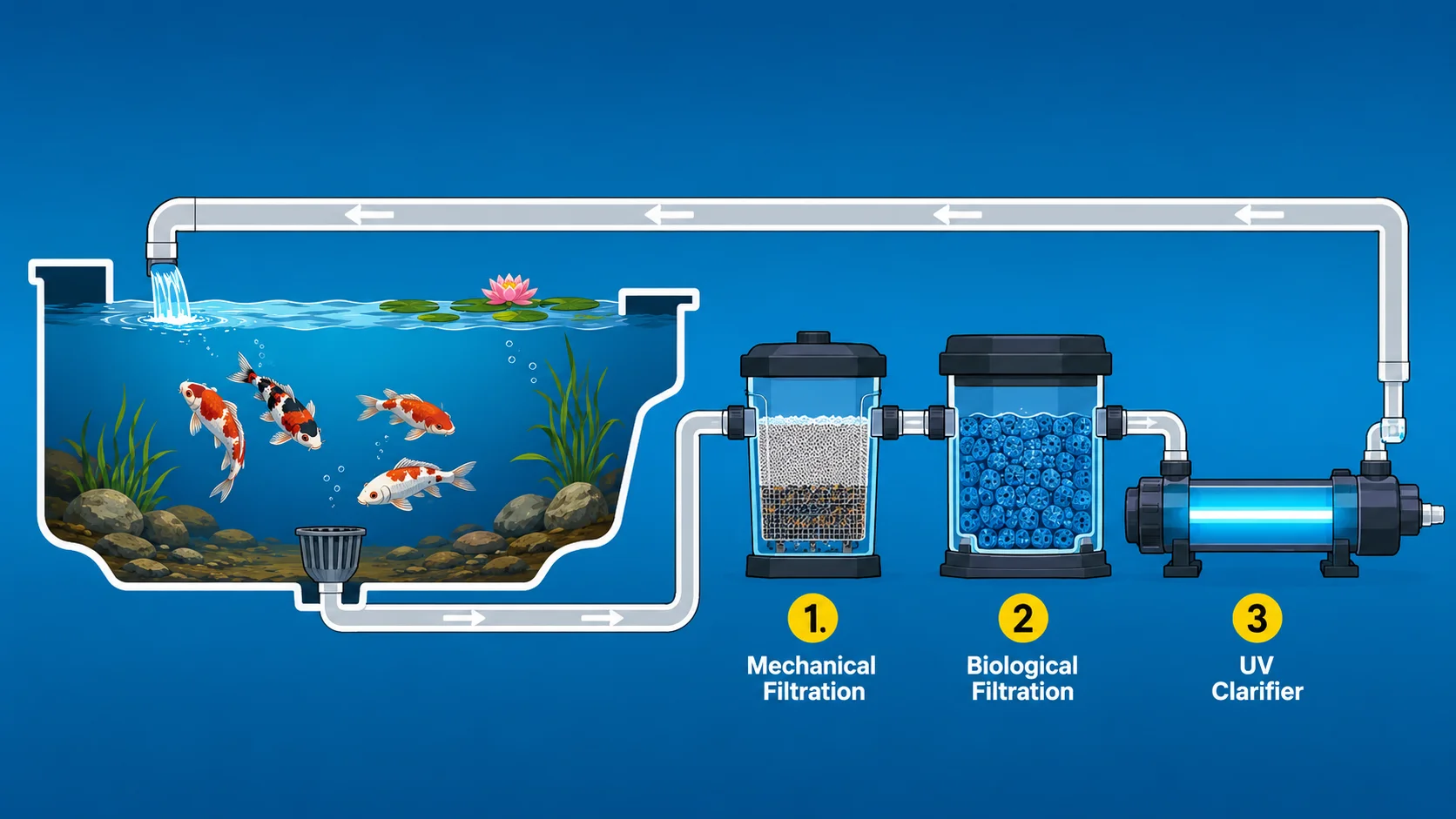
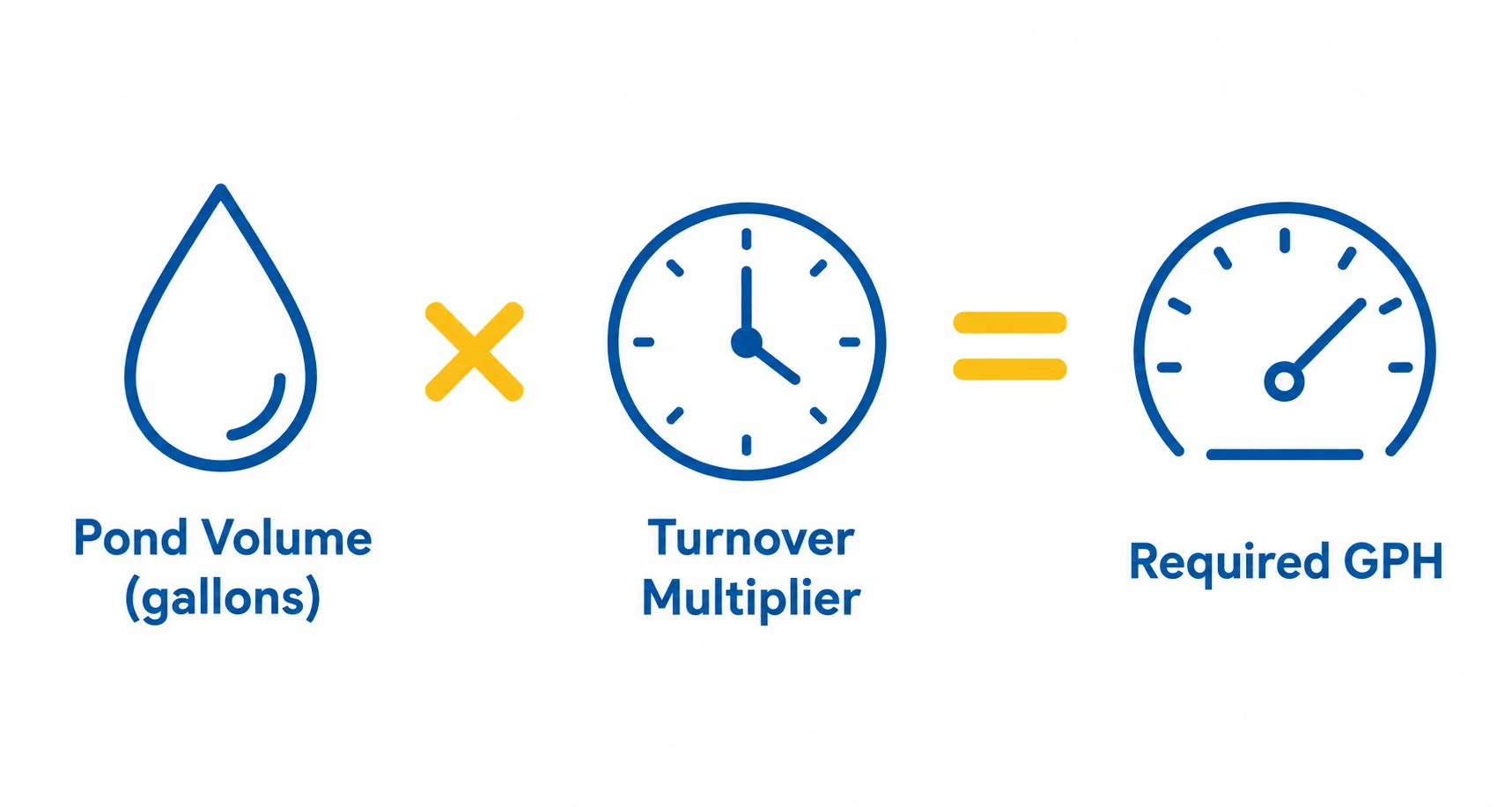
Your koi pond filter needs to circulate your entire pond volume every 1–2 hours (GPH). The formula: Pond Volume × Turnover Multiplier = Required GPH. Light stocking uses a 1x multiplier, moderate stocking 1.25–1.5x, and heavily stocked ponds need 1.5–2x. A good system combines mechanical filtration (traps debris) with biological filtration (beneficial bacteria that convert ammonia into safer nitrates), and most koi ponds benefit from a UV clarifier too.

VEVOR Bio Pressure Pond Filter, Up to 1600 Gallons, 13W UV-C Light
1580 GPH pressurized biological pond filter with integrated UV-C light for algae control. Good starting point for small-to-medium koi ponds.
What Does a Koi Pond Filter Actually Do?
Think of a koi pond filter as a miniature wastewater treatment plant for your fish. It continuously removes:
- Excess waste — koi produce ammonia, which is toxic if it builds up
- Debris — leaves, twigs, and organic matter that cloud the water and clog equipment
- Harmful bacteria — unchecked bacterial growth can harm fish and make water unsafe
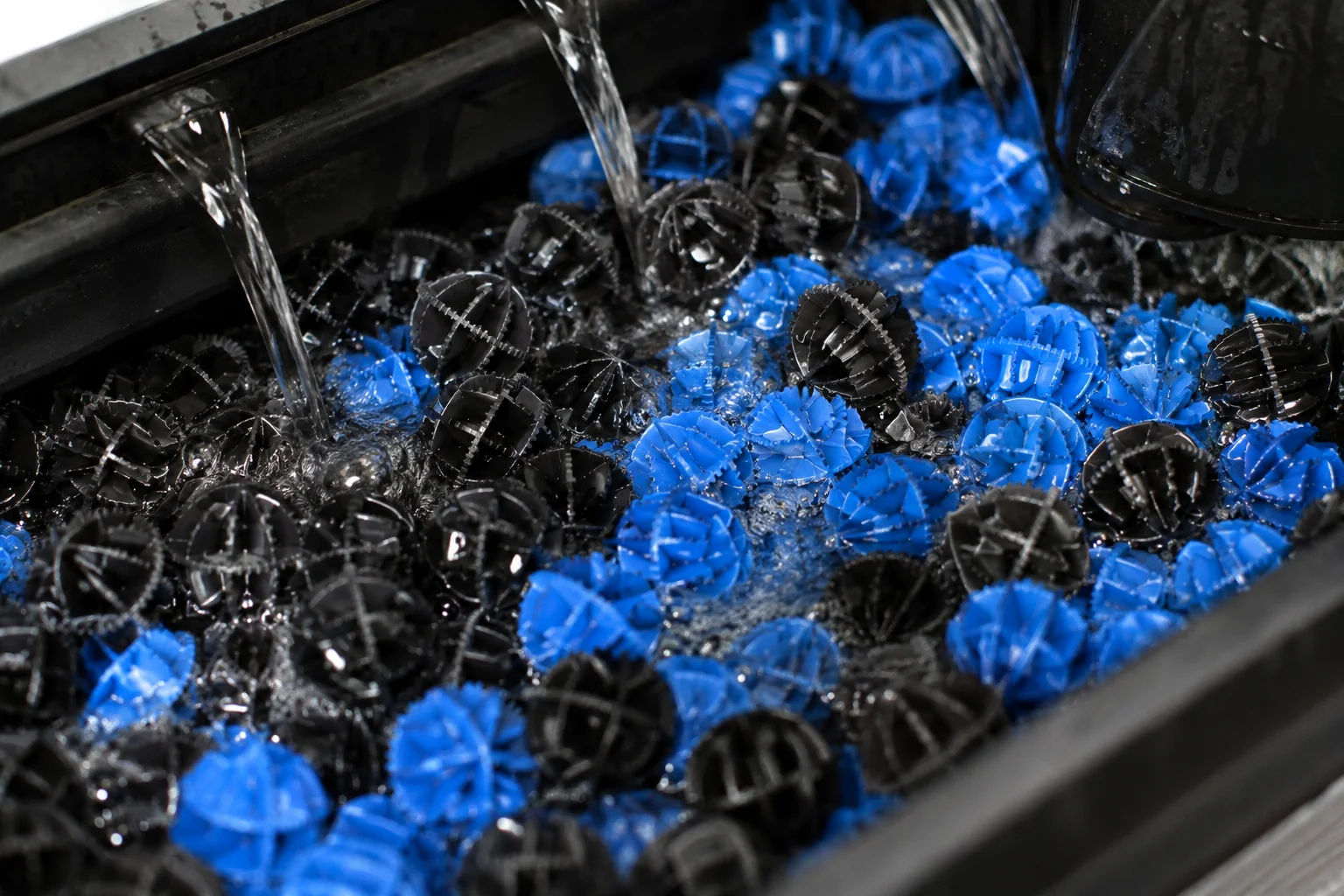
Water passes through media that traps debris while allowing beneficial bacteria to colonize. Those bacteria break down toxic ammonia into nitrites, then into far less harmful nitrates — this is called the nitrogen cycle, and it’s the biological engine that keeps a koi pond alive.
How to Size a Koi Pond Filter: The GPH Formula
This is the single most important thing most guides skip. Undersizing a filter is one of the most expensive mistakes in koi keeping — too small and ammonia spikes; too large and you’ve overspent on equipment that never runs at capacity.
| Stocking Level | Turnover Multiplier | Example (3,000-gal pond) |
|---|---|---|
| Light stocking | 1x per hour | 3,000 GPH minimum |
| Moderate stocking | 1.25–1.5x per hour | 3,750–4,500 GPH |
| Heavy stocking (1 koi per 250 gal or less) | 1.5–2x per hour | 4,500–6,000 GPH |
Want the exact number for your pond? Measure length × width × average depth × 7.5 to get gallons, then apply the multiplier above.
Skip the math: use our free Koi Pond Volume Calculator to get your exact gallons, then apply the turnover multiplier above to find your target GPH.
Open the Pond Volume CalculatorTypes of Koi Pond Filters Compared
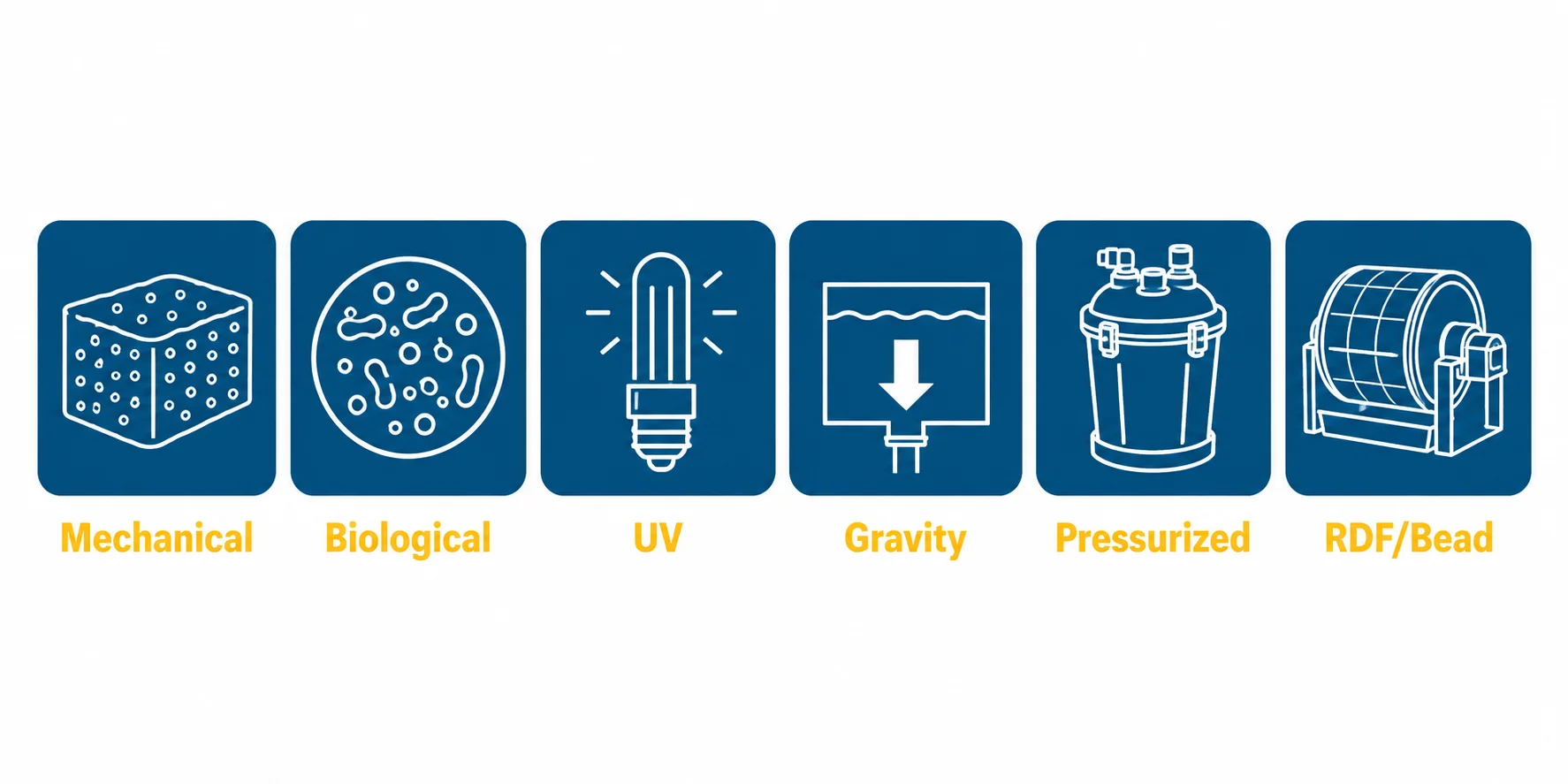
| Filter Type | How It Works | Best For |
|---|---|---|
| Biological | Beneficial bacteria colonize media and break down ammonia | Every koi pond needs this component |
| Mechanical | Physically traps debris via pads, sponges, or brushes | Removing visible waste and particulates |
| UV Clarifier | UV light disrupts algae reproduction, causing it to clump and get filtered out | Green water / algae control |
| Gravity-Fed | Above-ground, water flows down through media by gravity | Simpler setups, easier access for cleaning |
| Pressurized | Below-ground, pump pushes water through sealed media chamber | Larger ponds, hidden installation, higher flow |
| Rotary Drum (RDF) / Bead | Mechanically self-cleans via rotating drum or backwash valve | Larger, heavily-stocked ponds wanting less manual maintenance |
Choosing the Right Filter for Your Pond
The ideal filter depends on three factors:
- Pond size — larger ponds need more powerful filtration to handle the increased water volume and fish waste
- Number and size of fish — more (and bigger) koi means more waste, so filtration capacity needs to scale with your actual stocking, not just your pond’s size on day one
- Budget — filters range widely in price depending on capacity, self-cleaning features, and UV integration
Most experts recommend a filter able to handle at least 33% of your total pond volume in circulation; don’t go below 10% even on a tight budget, since underpowered filtration is the fastest way to lose fish.
Top Koi Pond Filters
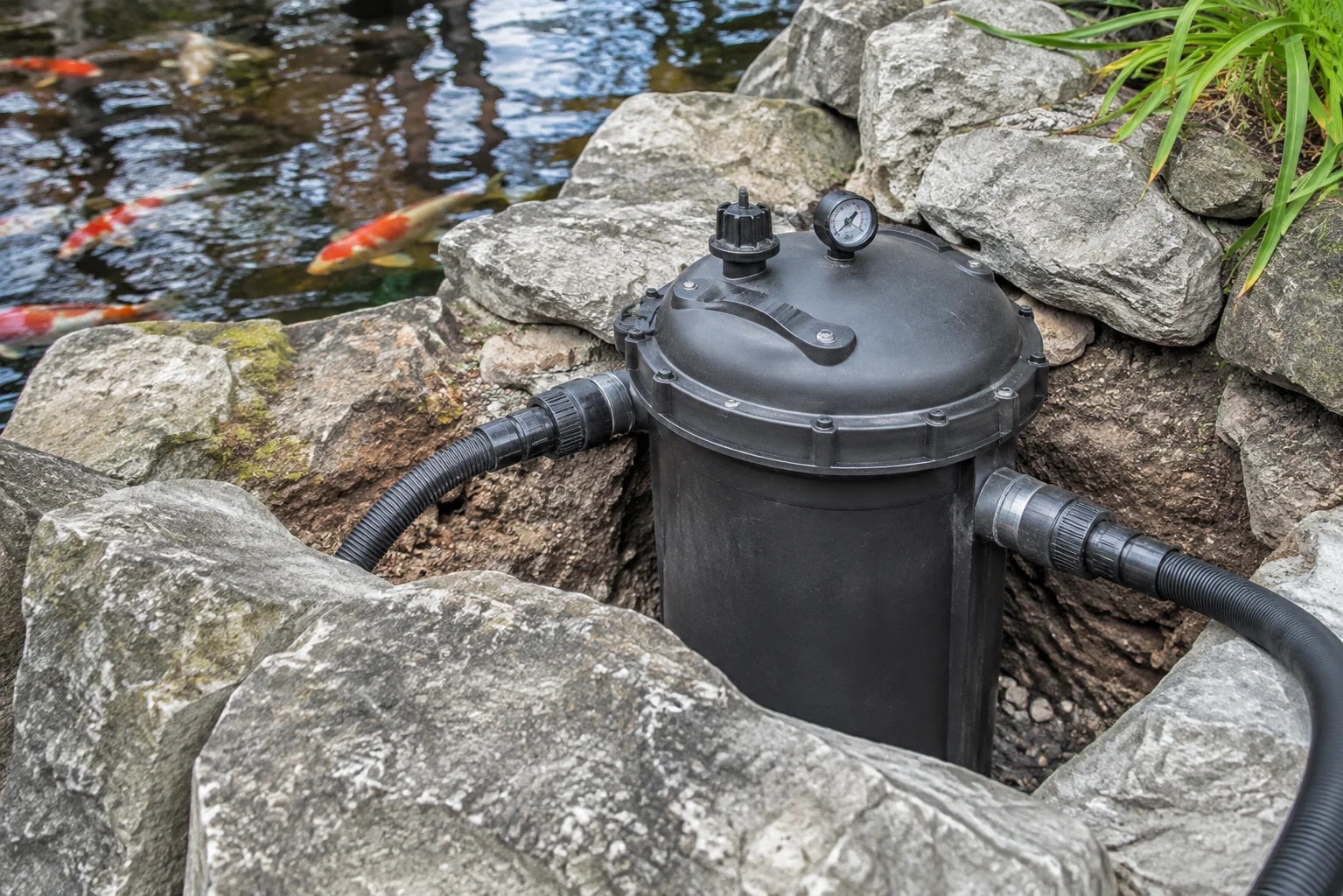
XtremepowerUS Koi Pressure Bio Filter with UV Sterilizer
- 13W UV light, 10,000 liters/hour (suitable for up to 4,000-gal ponds)
- 3 layers of sponges for beneficial bacteria colonization
- Connections: 3/4″, 1″, 1 1/4″, 1 1/2″ (pond pump required separately)

SUN Grech CPF-2500 Pond Bio Pressure Filter (13W UV-C, up to 1,600 Gal)
- Biological and mechanical filter chambers in one unit
- Quick-handle backflush cleaning — no need to open and manually clean foams
- Suitable for decorative ponds up to ~1,600 gal, or ~900 gal with a small koi mix
- Includes 720 GPH pump; max head 9.2 ft

TetraPond Bio-Active Pressure Filter with UV Clarifier
- Open-profile bio-activators provide large surface area with unrestricted flow
- Easy backflush valve for fast cleaning
- Available in 1,500 / 2,500 / 4,000-gallon capacities (9W–18W UV)

OASE BioSmart 5000 Pond Filter
- Flow-through design with mechanical + biological filtration and strong oxygenation
- Sludge drain for easy coarse-debris removal — no manual foam unclogging
- Built-in cleaning indicator and water temperature display
- Suitable for ponds up to 5,000 gallons (with no fish) or ~1,600 gal with the UVC version
TotalPond UV Clarifier (9W, up to 2,000 Gallons)
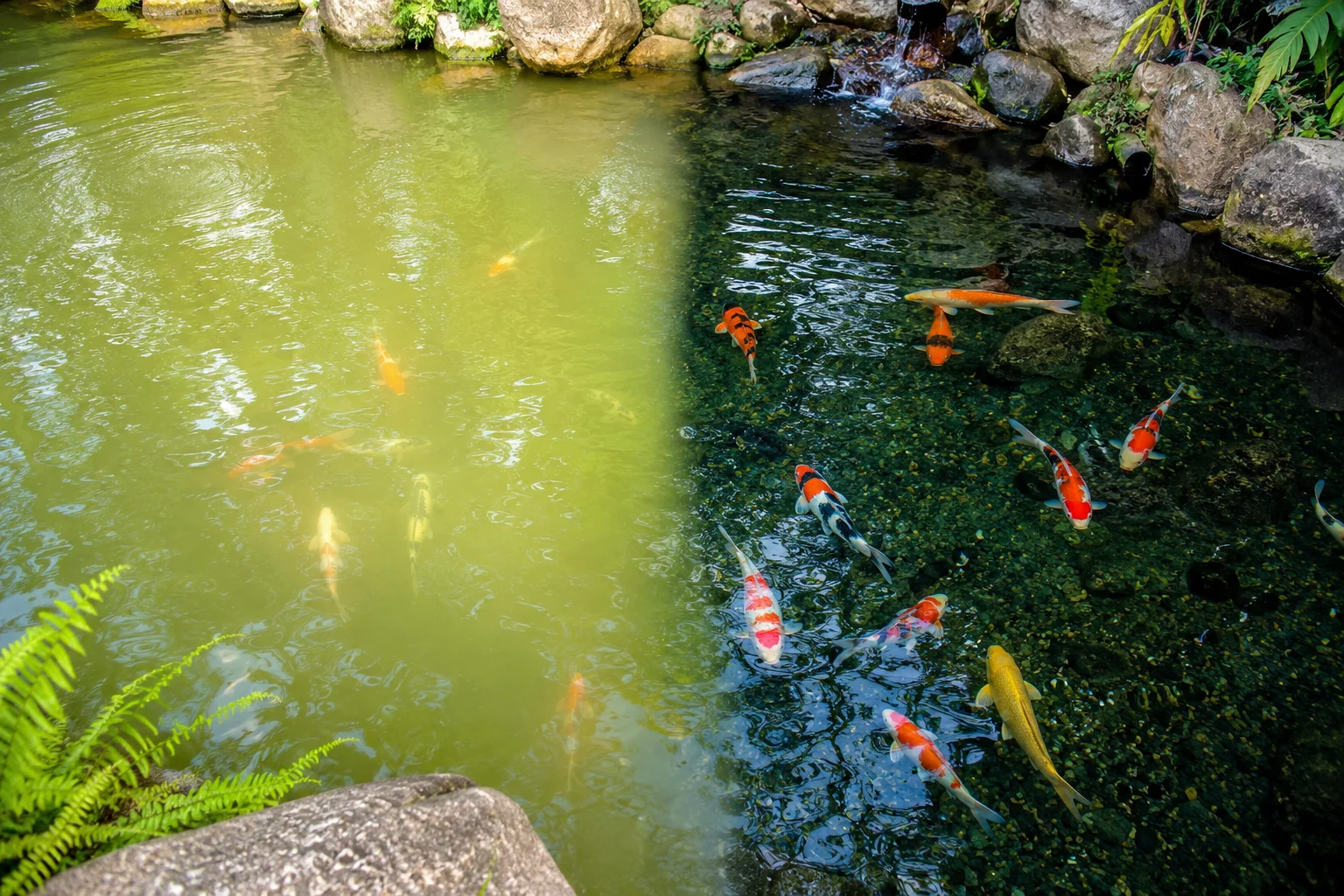
- Reduces algae-causing micro-organisms and bacteria via UV sterilization
- 9W bulb lasts up to 8,000 hours; replace yearly for best performance
- Connects to 1/2″, 3/4″, or 1″ ID tubing on a pump outlet

TetraPond In-Pond Skimmer
- Pre-filter that removes surface debris before it sinks and protects the pump from clogging
- Draws water into a basket and replaceable filter pad
- For flexible or pre-formed ponds, 500–1,000 gallons
Replacement Bio Media
Rebuilding or expanding your biological filter chamber? Bio balls filter media (100 pcs, free shipping) and K1 filter media are both available in our shop.
DIY vs. Pre-Made Filters
A DIY biofilter (a resealable bin, rubber hose, and pump) can work for a tight budget, but factor in real costs: media, plumbing fittings, waterproofing, and your own time. For most hobbyists, a pre-made pressurized or gravity filter ends up cheaper once labor and trial-and-error are counted — and it comes with a manufacturer-rated GPH you can actually size against.
Common Mistakes When Choosing a Koi Pond Filter
- Sizing for today’s fish, not tomorrow’s. Koi grow fast — a filter that’s adequate now may be undersized within 2–3 years. See our koi growth guide for realistic size expectations.
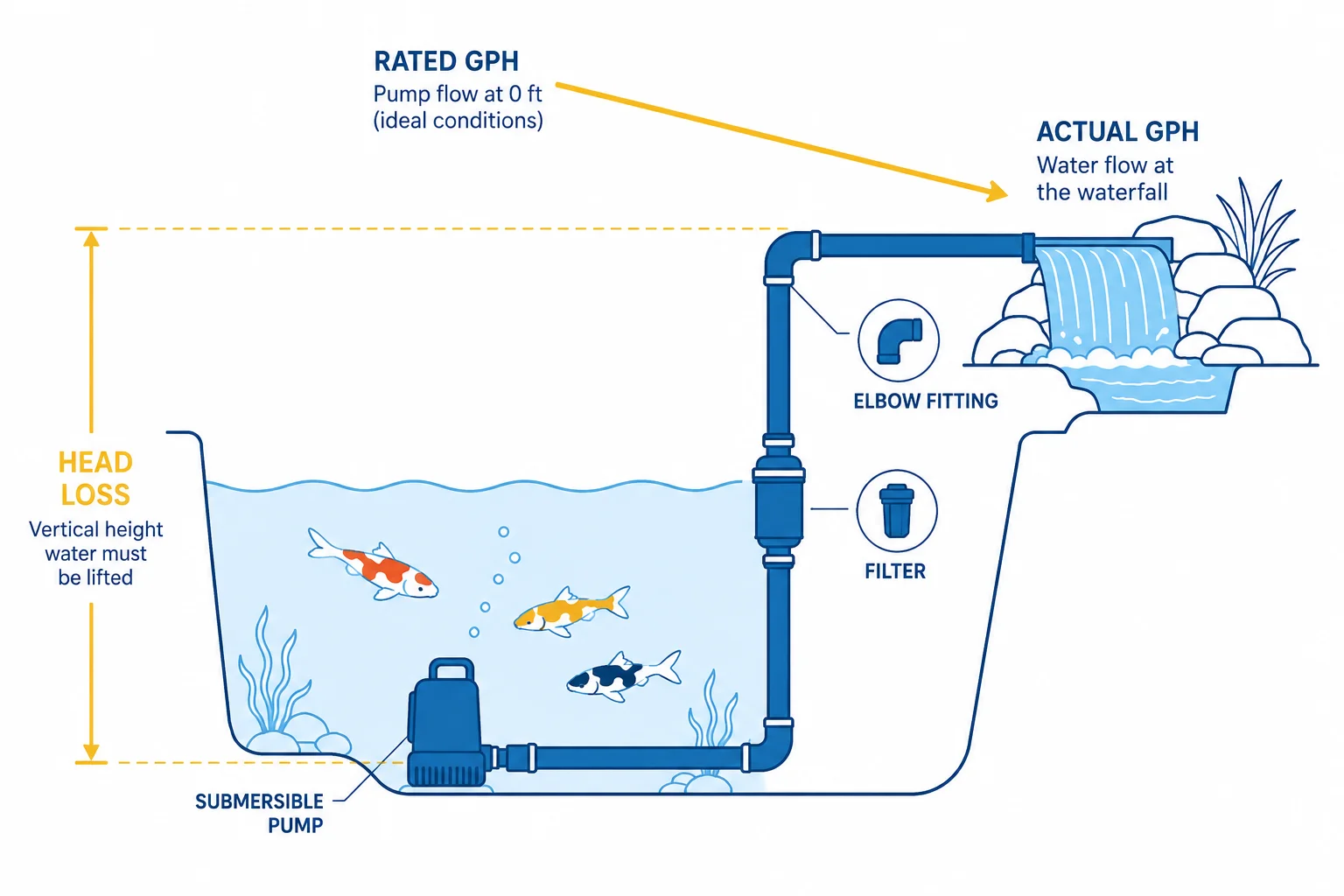
- Ignoring head loss. A pump’s rated GPH is measured at zero resistance — real-world flow after plumbing and elevation is always lower.
- No backup pump. Pumps fail eventually. When they do, your biological filter starts dying within hours. A spare submersible pump buys critical time.
- Skipping the cycle-in period. A new biofilter typically takes 4–6 weeks to establish enough beneficial bacteria to be fully effective — introduce new fish slowly during this window.
FAQs
Does a koi pond need a filter?
Yes. Koi produce far more waste than most pond fish, and without filtration, ammonia builds to lethal levels quickly. A koi pond needs a bottom drain, surface skimmer, pump, filter, and typically a UV clarifier.
How do I size a filter for my koi pond?
Multiply your pond’s gallons by a turnover multiplier: 1x for light stocking, 1.25–1.5x for moderate, and 1.5–2x for heavy stocking. That gives you the minimum GPH your pump and filter need to handle.
What is the difference between mechanical and biological filtration?
Mechanical filtration physically traps debris and waste particles. Biological filtration uses beneficial bacteria to convert toxic ammonia into safer nitrates. A complete system uses both.
How long does a new biofilter take to start working?
Typically 4 to 6 weeks for a new pond’s biological filter to establish an effective bacteria colony. Introduce fish slowly during this period.
How do I clean a bio filter?
Remove the biological media during routine maintenance and rinse it in pond water until free of large debris. Never use chlorinated tap water to clean it — chlorine kills the beneficial bacteria you’re trying to preserve.
What size pump do I need for my filter?
Match the pump’s rated GPH (accounting for head loss) to your filter’s rated flow range, and to the turnover target for your pond’s stocking level. Our Pond Volume Calculator can help you get the base gallon figure first.
How do I keep my koi pond filter from freezing in winter?
For ponds 2.5–3 feet deep where fish stay outdoors year-round, insulate exposed equipment with straw, styrofoam, or plywood — but never fully cover the water’s surface, since fish still need gas exchange in winter.
You May Also Like
Passionate about fish keeping since elementary school in the 1980s, Giovanni Carlo has dedicated countless hours to collecting and breeding a diverse array of ornamental freshwater fish. From vibrant guppies and majestic koi to striking bettas and classic goldfish, he continues to explore the fascinating world of aquatics, sharing knowledge and enthusiasm with fellow fish enthusiasts.

Passionate about fish keeping since elementary school in the 1980s, Giovanni Carlo has dedicated countless hours to collecting and breeding a diverse array of ornamental freshwater fish. From vibrant guppies and majestic koi to striking bettas and classic goldfish, he continues to explore the fascinating world of aquatics, sharing knowledge and enthusiasm with fellow fish enthusiasts.