

Koi Pond Design Ideas: 12 Styles for Every Budget & Space
By Giovanni Carlo · Koi keeper & founder, Giobel Koi Center · Updated June 9, 2026

Quick Answer
The 12 best koi pond design styles are: Japanese garden, natural rock, waterfall, raised, formal/geometric, minimalist, cottage garden, multi-level cascade, courtyard, wildlife-friendly, deck-integrated, and small space / compact. The most important design rules regardless of style: minimum 3–4 feet deep, at least 1,000 gallons, quality biological filtration, and 40–60% surface plant coverage to prevent algae.
In This Guide
- Choose Your Style: Design Decision Guide
- Size & Depth Guide
- Style 1 — Japanese Garden Koi Pond
- Style 2 — Natural Rock Koi Pond
- Style 3 — Waterfall Koi Pond
- Style 4 — Raised Koi Pond
- Style 5 — Formal / Geometric Koi Pond
- Style 6 — Minimalist Modern Koi Pond
- Style 7 — Cottage Garden Koi Pond
- Style 8 — Multi-Level Cascade
- Style 9 — Courtyard Koi Pond
- Style 10 — Deck-Integrated Koi Pond
- Style 11 — Small Space / Compact Koi Pond
- Style 12 — Wildlife-Friendly Koi Pond
- Cost Guide: What Each Style Costs
- Best Plants for Every Koi Pond Style
- 5 Design Mistakes to Avoid
- Frequently Asked Questions
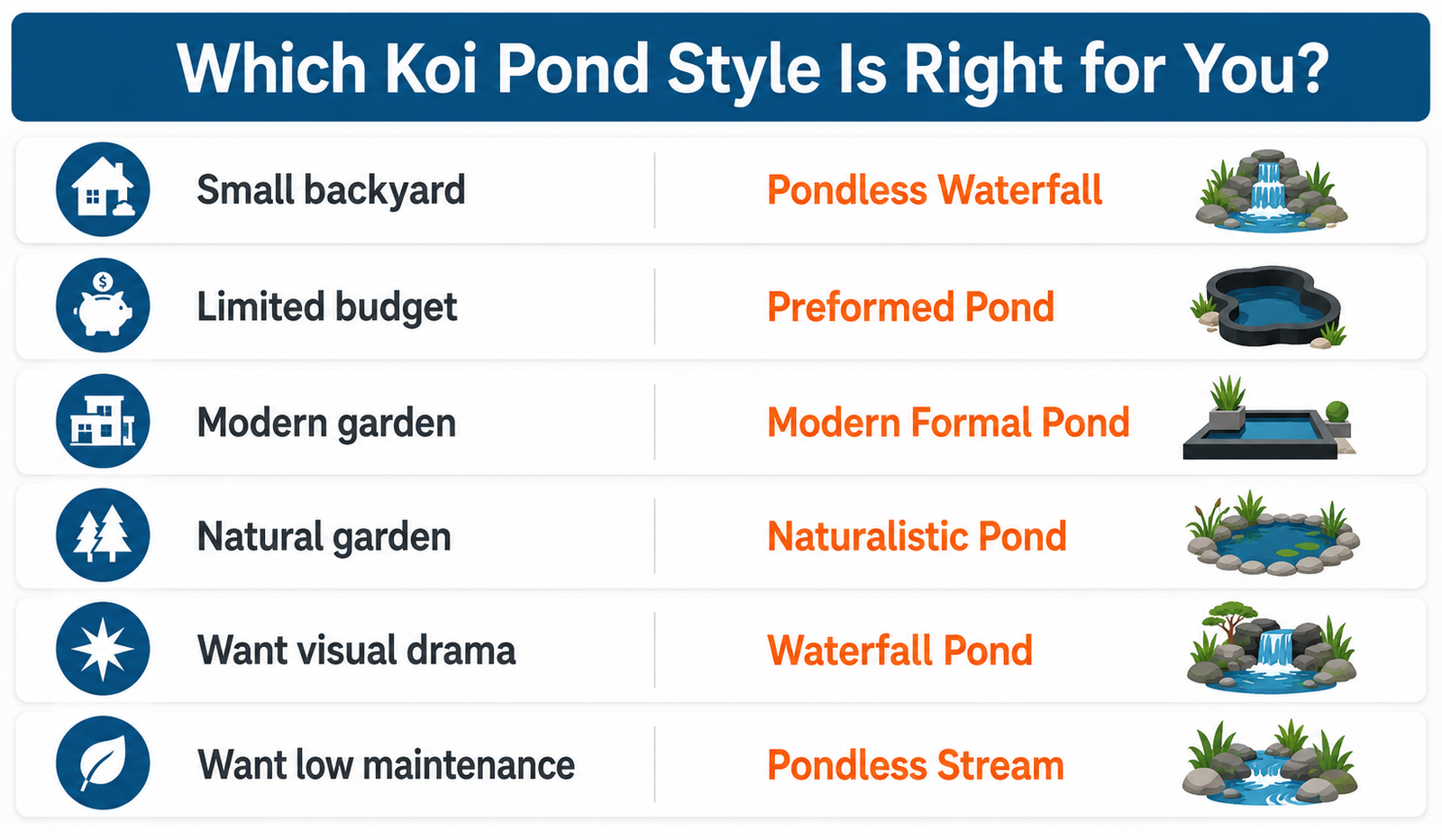
Choose Your Style: Design Decision Guide
Before choosing a design, answer these three questions — they will narrow your choices immediately:
| Your Situation | Best Style(s) | Avoid |
|---|---|---|
| Small backyard (under 200 sq ft) | Raised pond, compact/small space, courtyard | Multi-level cascade, large natural |
| Limited budget (under $5,000) | Natural rock (DIY), simple waterfall, formal liner pond | Deck-integrated, multi-level, luxury formal |
| Modern / contemporary garden | Minimalist modern, formal geometric, raised | Cottage garden, wildlife-friendly |
| Traditional / natural garden | Japanese garden, natural rock, cottage garden | Minimalist concrete, formal geometric |
| Want maximum visual impact | Multi-level cascade, waterfall, deck-integrated | Simple liner with no features |
| Want low maintenance | Formal geometric, minimalist, raised | Wildlife-friendly, cottage garden (high plant maintenance) |
Size & Depth Guide: Getting the Fundamentals Right
Every beautiful koi pond design fails if the fundamentals are wrong. Before choosing a style, commit to these non-negotiable size requirements:
| Pond Size | Volume | Max Koi | Best For |
|---|---|---|---|
| Avoid: under 500 gal | Under 500 gal | 1–2 only | Not recommended — poor water quality |
| Small | 500–1,500 gal | 2–5 koi | Compact, raised, courtyard designs |
| Medium | 1,500–3,000 gal | 5–10 koi | Japanese, natural, waterfall styles |
| Large | 3,000–6,000 gal | 10–20 koi | Multi-level, deck-integrated, cottage garden |
| Ideal ✦ | 6,000+ gal | 20+ koi | All styles — maximum flexibility |
Depth Rule — Never Compromise This
Minimum 3 feet deep, ideally 4–5 feet. Shallow ponds overheat in summer, freeze too quickly in winter, and give herons easy access to your fish. Depth is the one design element you cannot correct cheaply after building.
Free Tool
Not sure how big your pond should be?
Use our free Koi Pond Volume Calculator — enter your length, width, and depth and instantly get your pond’s water volume in gallons and litres, plus stocking recommendations and filter sizing guidance.
Style 1 — Japanese Garden Koi Pond
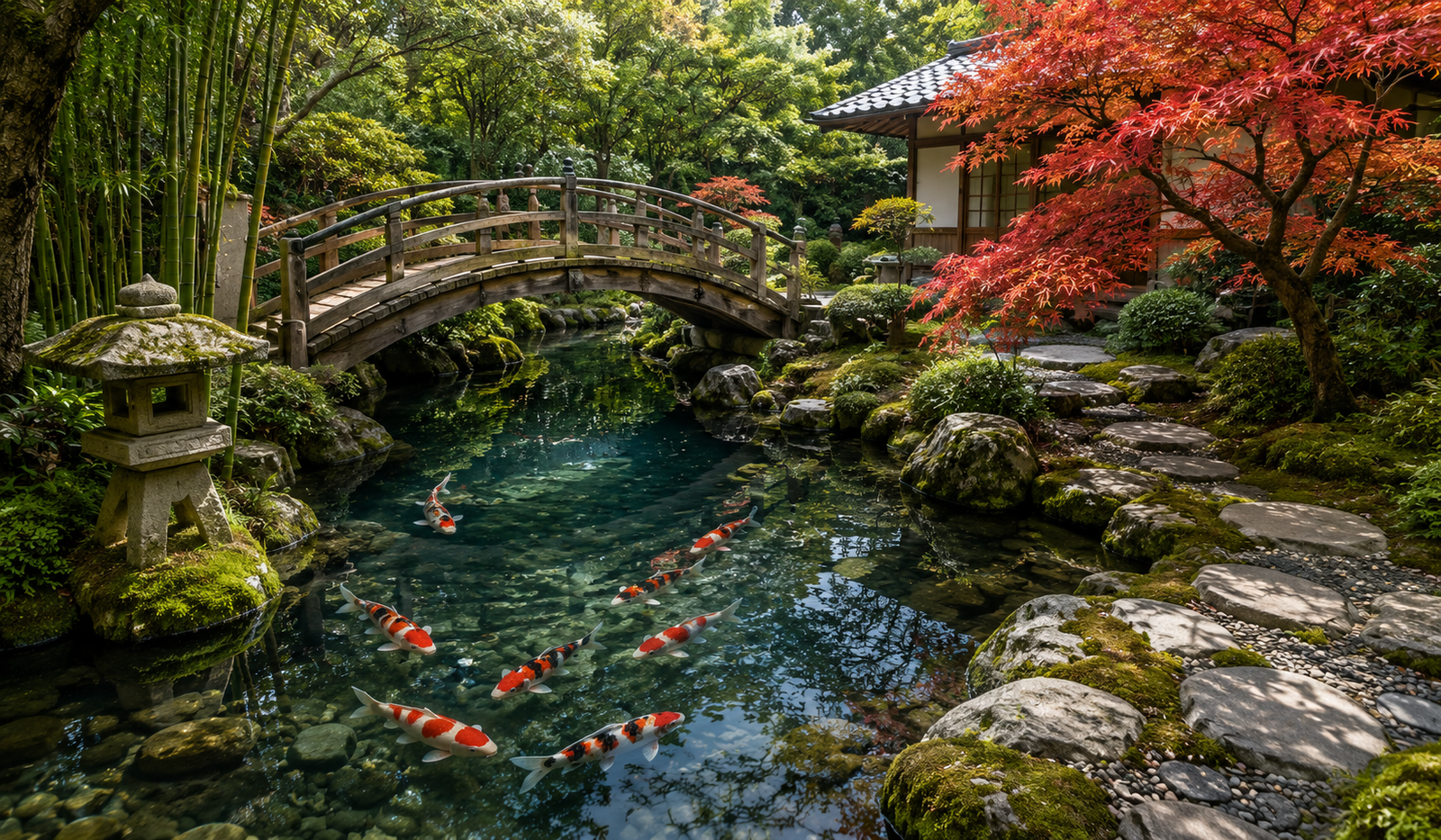
The Japanese garden koi pond is the gold standard — the style that gave rise to the entire global koi hobby. It draws on centuries of Japanese garden design philosophy (wabi-sabi — finding beauty in imperfection and impermanence) to create a space that feels simultaneously natural and meticulously considered.
Key elements:
- Irregular, organic shape — never perfectly symmetrical; follows the natural contours of the land
- Arched wooden bridge — the classic taiko-bashi (drum bridge) creates a focal point and allows viewing from above
- Stone lantern (toro) — placed near the water’s edge, traditionally lit at dusk
- Tsukubai — a stone water basin with bamboo spout adding gentle sound
- Japanese maples, bamboo, moss — planted sparsely to create depth without clutter
- Koi visibility — water clarity is paramount; this style is designed for viewing fish from multiple angles
The Japanese style rewards patience — plants take time to mature, rocks weather naturally, and the pond deepens in character over years rather than seasons.
Style 2 — Natural Rock Koi Pond
The natural rock pond blends seamlessly into its landscape — it looks as though water gathered there naturally rather than being constructed. Large flat boulders form the edging, smaller river rocks line the shallow margins, and aquatic plants grow in clusters as they would in nature. This is the most popular style for rural and semi-rural settings.
Key elements: Irregular boulder edging in two or three sizes — large (focal point), medium (fill), small (gap filling). Avoid using only one rock size — it looks artificial. Use locally sourced stone when possible; imported stone rarely matches the surrounding landscape. Add a flat viewing boulder near the edge where you can sit and watch the koi.
Style 3 — Waterfall Koi Pond
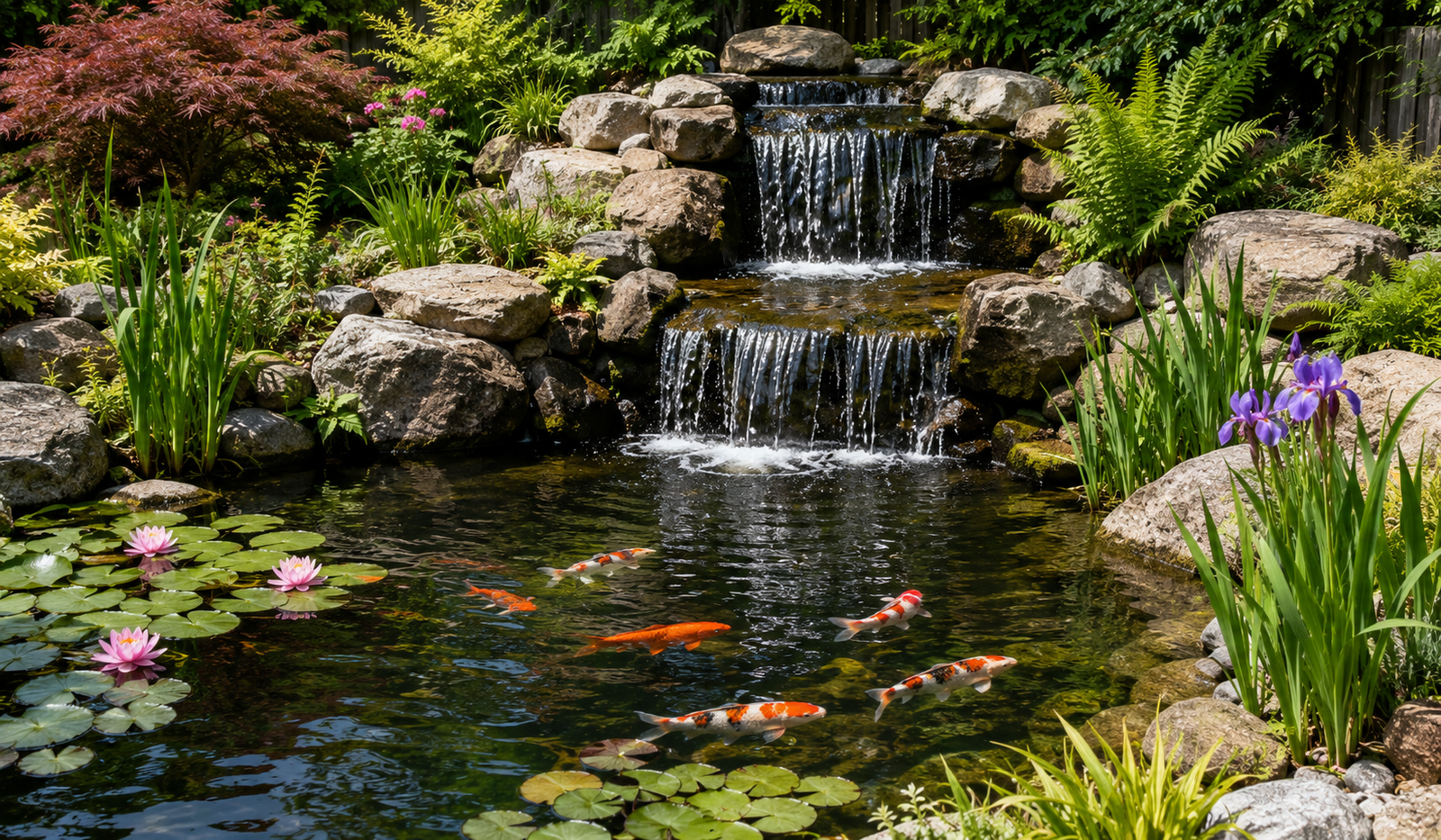
A waterfall transforms a static pond into a living feature — adding movement, sound, oxygenation, and visual drama simultaneously. Beyond aesthetics, waterfalls serve a critical functional purpose: the surface agitation they create dramatically increases dissolved oxygen levels, which is essential for koi health especially in warm summer months.
Waterfall design options:
- Single drop waterfall — classic, easy to build, effective; water falls from one rock shelf into the pond
- Multi-tier cascade — water steps down through 3–5 levels; creates more sound and visual interest
- Sheet waterfall — a broad, thin curtain of water over a flat ledge stone; more dramatic, requires precise stone selection
- Bog/stream feed waterfall — water flows through a planted bog filter before cascading — combines filtration and visual beauty
Always position the waterfall outlet at the far end of the pond from the filter intake — this ensures water circulates through the entire pond volume rather than short-circuiting back to the filter immediately.
Style 4 — Raised Koi Pond
A raised koi pond is constructed above ground — its walls visible and decorative, often clad in stone, brick, timber, or render. It offers several practical advantages: no excavation required, easier maintenance (no bending), better predator protection, and the ability to be placed on a patio or hardstand area where digging isn’t possible.
Wall material options: Natural stone (most attractive, expensive), brick or block with stone coping (classic look), rendered block (modern, can be painted), railway sleepers or hardwood (warm, rustic), fibreglass or GRP (durable, watertight, modern). The wall height should allow comfortable viewing — 24–30 inches from ground to water surface is ideal for viewing fish without bending. Wall thickness must support the hydrostatic pressure of the water.
Style 5 — Formal / Geometric Koi Pond
The formal pond uses precise geometric shapes — rectangle, square, circle, or L-shape — and clean, symmetrical construction. It suits classical or traditionally styled gardens and architectural settings where organic shapes would feel out of place. Concrete or block construction finished with natural stone coping gives a formal pond its characteristic permanence and elegance.
Key design principles: The pond axis should align with the main axis of the garden or house. Use the same stone for pond coping as for adjacent paths or terraces — consistency is the hallmark of formal design. A central fountain jet adds vertical interest without breaking the clean lines. Plant minimally — a few statement water lilies rather than a mass planting.
Style 6 — Minimalist Modern Koi Pond
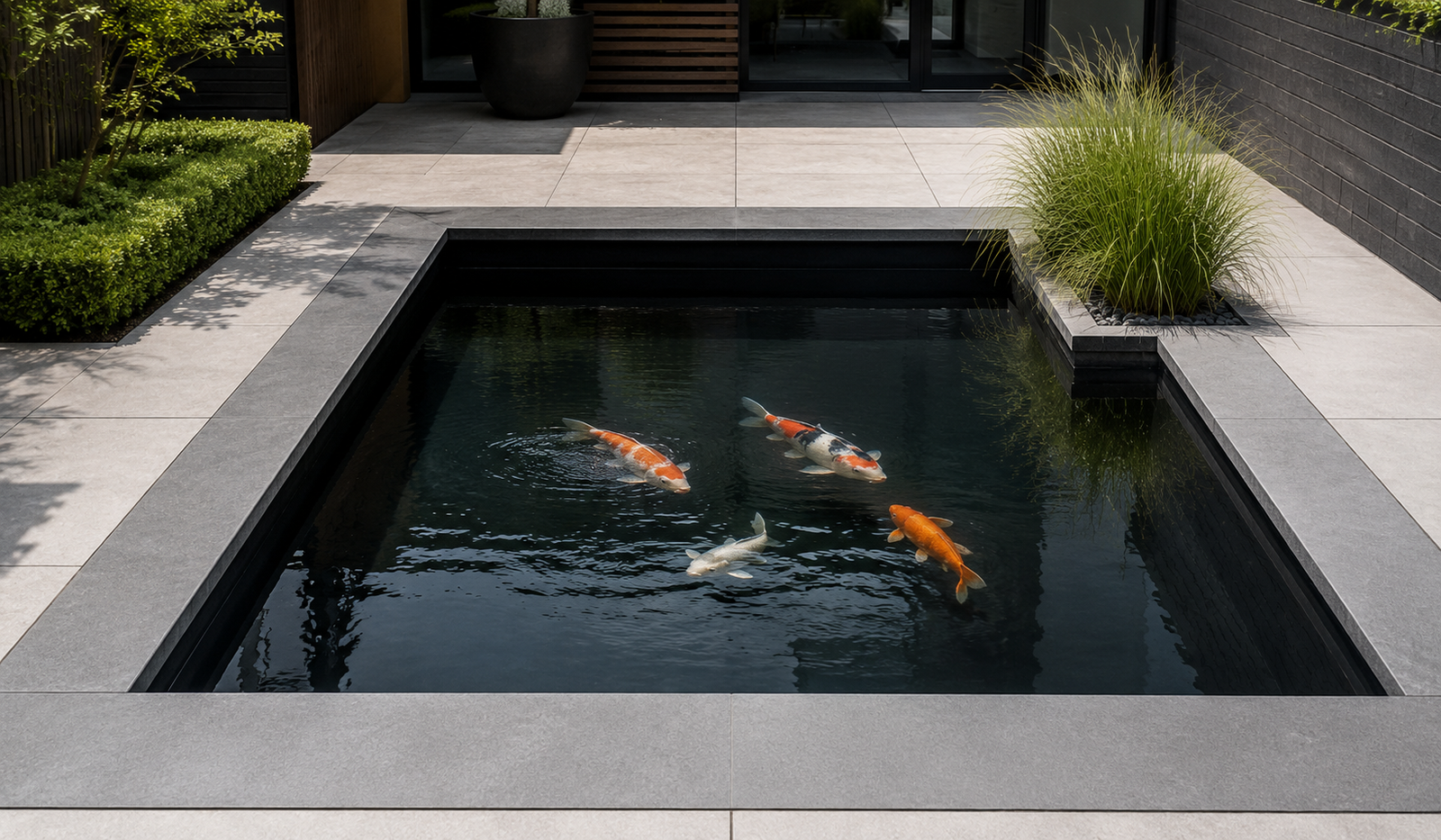
The minimalist pond is defined by restraint — clean lines, limited materials, and the koi themselves as the primary visual element. Nothing competes with the fish. A minimalist pond works in modern architectural settings and typically features a dark interior (black or dark grey liner or render), which dramatically improves koi visibility by creating contrast against their vivid colors.
Key design principles: One material for all hardscape (e.g., all Corten steel, all dark sandstone, or all smooth concrete). No more than two plant species. Concealed filtration — all pipes, filters, and mechanical equipment completely hidden. Underwater LED lighting creates an extraordinary evening effect. The dark pond interior is non-negotiable — it transforms koi from pond fish into floating jewels against a dark canvas.
Style 7 — Cottage Garden Koi Pond
The cottage garden pond overflows with life — dense planting, informal edges, abundant color, and the relaxed abundance associated with English cottage gardens. Water lilies spread across the surface, marginal plants crowd the edges, and the pond feels as though it grew there naturally over decades. This is the highest-maintenance style but rewards with extraordinary year-round visual richness.
Key plants: Water lilies (essential), water iris in purple/yellow/white, water mint, flowering rush, loosestrife at margins, primulas and astilbe behind. Allow some algae on rocks — it adds to the naturalistic effect. A simple fountain or small waterfall adds sound without disrupting the cottage atmosphere.
Style 8 — Multi-Level Cascade Pond
A multi-level cascade uses the natural slope of a garden to create a series of interconnected ponds at different elevations, linked by waterfalls and streams. It is the most dramatic and immersive koi pond design — the sound of falling water fills the garden, and the interconnected system creates a complete aquatic ecosystem rather than a single static pond.
Design principles: The main koi pond is always at the lowest level — the deepest, largest, and most heavily filtered. Upper levels can serve as settlement ponds, bog filters, or holding areas. The gradient between levels determines waterfall height — aim for variety (some gentle cascades, one dramatic drop). Use a single recirculation pump drawing from the lowest pond and returning filtered water to the highest. This creates a self-cleaning system where solids settle down and water flows up.
Style 9 — Courtyard Koi Pond
A courtyard pond is designed to be the central focal point of an enclosed outdoor space — a walled garden, inner courtyard, or terrace. The enclosed setting means the pond is viewed close-up and from multiple sides, so clarity and fish visibility are paramount. Raised construction is common, with the pond walls becoming part of the seating or boundary wall design.
A wooden walkway or decked path around the pond edges allows close viewing and can create the sensation of being surrounded by water. Tall bamboo or climbers on the surrounding walls complete the enclosure. Night lighting — both above and below water — transforms a courtyard pond into a spectacular evening feature.
Style 10 — Deck-Integrated Koi Pond
The deck-integrated pond builds the pond directly into a timber or composite deck — the water surface appears to flow beneath the deck boards, creating the impression that you are standing over the water. Glass viewing panels in the deck allow looking directly down onto the koi. This is the most social and entertainment-focused design — perfect for outdoor dining areas where guests can watch fish while eating.
The deck provides full surrounding access and heron protection (koi can retreat under the deck overhang). The raised water level should reach close to deck surface level for the best visual effect. Concealed filtration under the deck keeps the aesthetic clean.
Style 11 — Small Space / Compact Koi Pond
A small koi pond is perfectly viable — the key is choosing smaller koi varieties (standard koi under 14 inches, or smaller pond-specific varieties) and accepting that water quality management requires more frequent attention in a smaller volume. A well-designed 500–1,000-gallon pond can house 2–4 koi beautifully.
Small pond tips: Go deep rather than wide — a 500-gallon pond 3 feet deep is far better for koi than a 500-gallon pond 18 inches deep. Use a quality pressurized filter rated for double the pond volume. Plant densely to absorb nutrients — small ponds swing in water quality faster than large ones. Consider butterfly koi — their long fins make them visually dramatic even at smaller body sizes.
See our guide: Indoor Koi Pond Setup Guide.
Style 12 — Wildlife-Friendly Koi Pond
A wildlife-friendly koi pond creates a full garden ecosystem — designed not just for koi but to attract birds, frogs, dragonflies, and beneficial insects. It requires a careful balance: koi will eat frog spawn and tadpoles, so a separate shallow wildlife area is essential. A beach entry zone (gradual slope of pebbles from shallow to deep) allows birds to bathe and small wildlife to enter and exit safely.
Key features: Shallow beach entry (2–6 inches deep) at one end; deep koi zone at the other; bog planting zone between the two. Native aquatic plants preferred. No fish nets or barriers between zones — wildlife moves freely. Minimal chemical treatments to preserve the biological community. This is the most ecologically rich design — a pond that gives back to the whole garden.
Cost Guide: What Each Style Costs
| Style | DIY Cost | Professional Cost | Main Cost Driver |
|---|---|---|---|
| Small / compact | $800–$2,000 | $2,000–$5,000 | Filter quality |
| Natural rock | $1,500–$4,000 | $4,000–$12,000 | Rock / stone sourcing |
| Raised pond | $1,500–$4,000 | $4,000–$10,000 | Wall material + coping |
| Waterfall pond | $2,500–$6,000 | $6,000–$20,000 | Waterfall rock + pump |
| Formal / geometric | $3,000–$7,000 | $7,000–$20,000 | Concrete construction |
| Japanese garden | $4,000–$10,000 | $10,000–$30,000 | Landscaping + bridge + lantern |
| Minimalist modern | $5,000–$12,000 | $12,000–$35,000 | Premium materials + lighting |
| Multi-level cascade | $6,000–$15,000 | $15,000–$50,000+ | Multiple pond construction + pumps |
| Deck-integrated | $8,000–$20,000 | $20,000–$60,000+ | Deck engineering + pond integration |
These are ballpark estimates — your actual cost depends on local labour rates, stone availability, and how much of the build you do yourself. Before finalising your budget, use our free Koi Pond Volume Calculator to confirm the exact water volume for your planned dimensions — this determines your filtration requirements and directly affects your equipment costs.
Best Plants for Every Koi Pond Style
| Plant | Type | Best Style | Benefit |
|---|---|---|---|
| Water lily | Floating | All styles | Shade, nutrient absorption, beauty |
| Water lettuce | Floating | All styles | Fast nutrient removal, algae prevention |
| Hornwort | Submerged oxygenator | All styles | Oxygen, nitrate removal, spawning cover |
| Bamboo | Marginal / background | Japanese, courtyard | Vertical structure, screening, wind sound |
| Japanese maple | Background tree | Japanese, natural | Autumn color, dappled shade |
| Water iris | Marginal | Cottage, Japanese, natural | Spring color, vertical structure |
| Cattail / bulrush | Marginal | Wildlife, natural | Native wildlife habitat, natural appearance |
| Lotus | Floating | Japanese, formal, large ponds | Dramatic flowering, cultural significance |
5 Design Mistakes to Avoid
1. Building too shallow
The single most common and most expensive mistake. A pond 18 inches deep will overheat, freeze, and give herons easy access. You cannot easily deepen an existing pond — get the depth right from the start. Minimum 3 feet; 4–5 feet preferred.
2. Undersizing the filtration
A beautiful pond with inadequate filtration will be a constant battle. Always purchase a filter rated for at least 1.5× your pond volume, from a koi-specific supplier. Generic pond filters are not rated for koi waste loads.
3. Placing the pond under trees
Falling leaves decompose into ammonia and cause algae blooms. Tree roots damage liners. In autumn, a pond under a deciduous tree requires daily skimming. Design with shade from man-made structures or carefully positioned plants, not overhanging trees.
4. Using sharp corners and complex shapes
Sharp corners create circulation dead zones where waste accumulates and bacteria thrive. Oval, round, and kidney shapes circulate water efficiently. If you want a geometric look, use rounded internal corners even in formal rectangular ponds.
5. Not planning heron protection
Herons are the #1 cause of koi loss worldwide. A heron can empty a pond of fish in one morning. Plan heron protection into the design — depth (4+ feet makes fishing difficult), overhanging ledges, netting, motion-activated deterrents, or electric fence wire around the perimeter.
More on predator protection: Deterring Herons from Your Koi Pond.
Related Reading on Giobel Koi Center
Frequently Asked Questions
What is the best koi pond design?
How deep should a koi pond be?
What shape is best for a koi pond?
How much does a koi pond cost?
What plants are best for a koi pond?
Can I build a koi pond myself?
Do koi ponds need a waterfall?

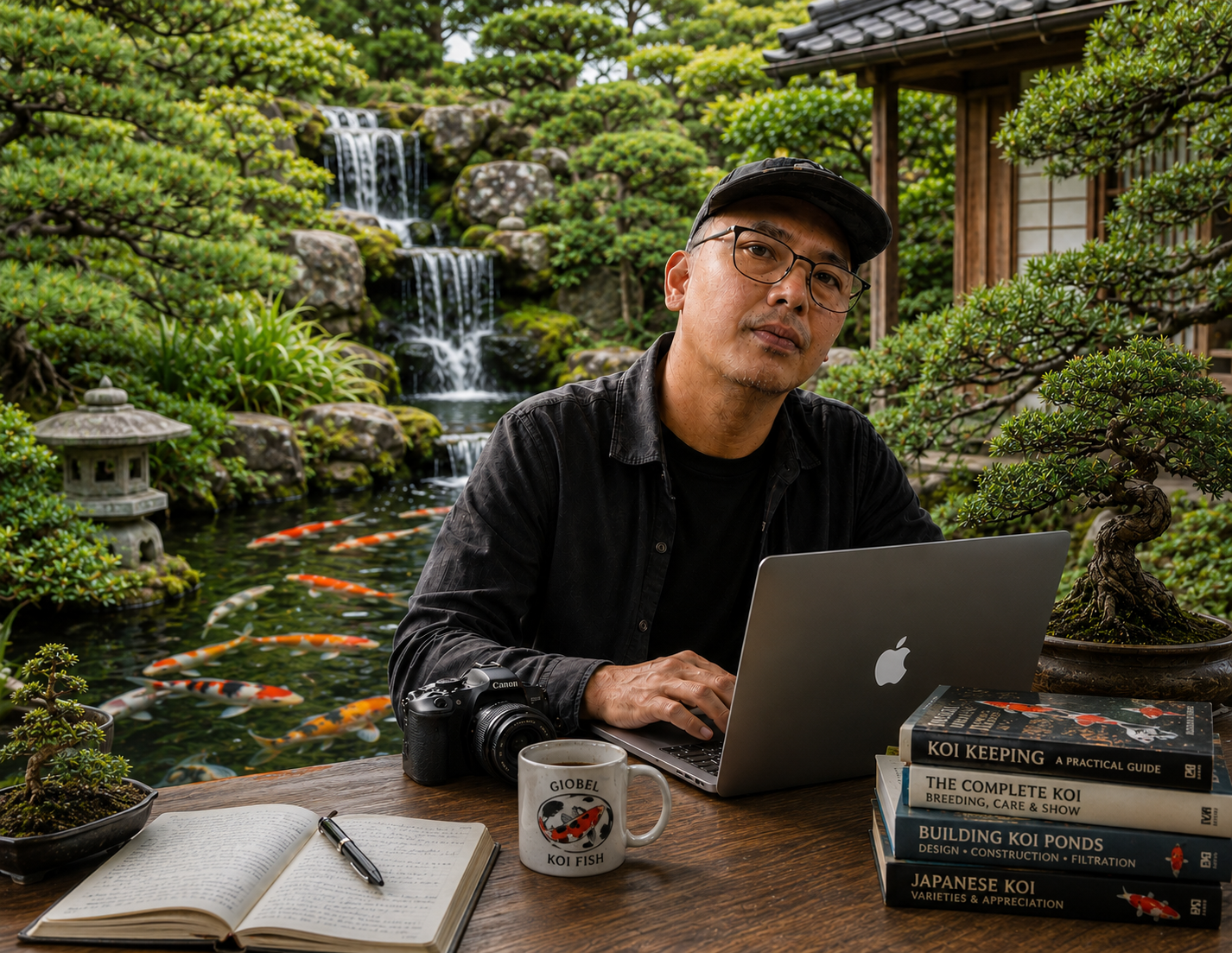
Giovanni Carlo
Koi keeper & founder, Giobel Koi Center · Labangan, Zamboanga del Sur
Giovanni has been keeping koi and building ponds since the 1980s on his farm in Mindanao. He has designed and maintained multiple koi ponds across a range of styles and budgets, and writes from decades of hands-on experience with pond construction, filtration, and koi care.


Passionate about fish keeping since elementary school in the 1980s, Giovanni Carlo has dedicated countless hours to collecting and breeding a diverse array of ornamental freshwater fish. From vibrant guppies and majestic koi to striking bettas and classic goldfish, he continues to explore the fascinating world of aquatics, sharing knowledge and enthusiasm with fellow fish enthusiasts.