Butterfly Koi: Complete Guide to Care, Size, Lifespan, Varieties and Fin Care
By Giovanni Carlo Bagayas | Updated: June 2026 | 15 min read
Quick Answer
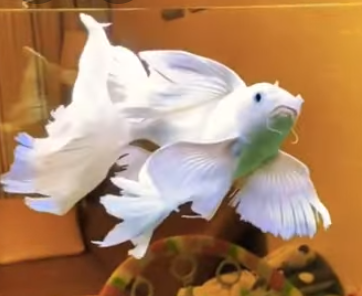
Butterfly koi (also called longfin koi or dragon koi) are ornamental koi bred from crossing traditional Japanese Nishikigoi with long-finned wild carp from Indonesia. They are defined by their dramatically elongated, flowing fins that continue growing throughout their lives. They grow to 24–36 inches, live 25–35 years, and come in every standard koi color pattern. They share identical care requirements with standard koi — with one critical addition: their long fins require special protection from sharp objects, fin rot, and aggressive pond mates. They are banned from traditional Japanese koi shows but have their own judging standards in the US.
What is a butterfly koi?
Butterfly koi — also known as longfin koi, dragon koi, or dragon carp — are a variety of ornamental koi fish that carry a genetic mutation producing dramatically elongated, flowing fins. Unlike standard koi whose fins are compact and proportional to their body, butterfly koi fins continue growing throughout their entire lives — stopping only when blood vessels can no longer supply nutrients to the fin tips.
The result is a fish of extraordinary visual drama: as it swims, long ribbons of fin trail behind it like silk in a gentle current. Viewed from above or from the side, the flowing fins form shapes resembling butterfly wings in flight — giving the variety its most popular name.
In Japan they are officially called Hirenaga (ひれ長 — “long fin”) or Onagagoi (尾長鯉 — “long tail carp”). The name “butterfly koi” was coined in the United States by Randy LeFever, son of noted koi breeder Wyatt LeFever, who observed that the flowing fins resembled butterfly wings.
From 40+ years of koi keeping
I kept my first butterfly koi in the 1990s when they were still a novelty in the Philippines. What struck me immediately was not just their appearance but how differently they move from standard koi. A pond of standard koi has energy — they dart and chase. A pond with butterfly koi has grace — they glide and drift. If you want a meditative, serene pond, butterfly koi create that atmosphere in a way standard koi simply cannot.
Origin and history — how butterfly koi were created
The butterfly koi story begins in July 1977, when Crown Prince Akihito of Japan (later Emperor Akihito) visited the Saitama Prefectural Fisheries Experiment Station. He mentioned a long-finned wild carp he had observed in Indonesia — Cyprinus carpio var. flavipinnis — and suggested it might be worth crossing with Japanese pond fish.
Prompted by this royal observation, the station began a breeding program in 1980. Two years later, in 1982, the first butterfly koi were produced — fish with the elaborate coloration of traditional Nishikigoi combined with the dramatically elongated fins of the Indonesian wild carp.
The variety spread to the United States through breeders in Pennsylvania, where it became enormously popular in the 1990s. American koi enthusiasts embraced butterfly koi enthusiastically — a reception that contrasted sharply with the skepticism of Japanese purists who considered them a departure from the classical Nishikigoi tradition.
Today butterfly koi are bred worldwide. They are among the most popular ornamental fish in the US, UK, and Southeast Asian markets — while remaining controversial in traditional Japanese koi circles.
Interestingly, the original imperial butterfly koi are still kept in a pond in the East Gardens of the Imperial Palace in Tokyo — a living connection to the variety’s royal origin.
How to identify butterfly koi

Identifying butterfly koi is straightforward once you know the four defining characteristics:
- Elongated flowing fins: The most obvious identifier — dorsal, pectoral, ventral, and caudal fins are all dramatically longer than in standard koi. In mature specimens, fins often equal half to three-quarters of the fish’s body length.
- Long barbels (whiskers): Butterfly koi have noticeably longer barbels around their mouth than standard koi — these can fork and grow into elaborate designs in older fish.
- Slimmer body profile: Butterfly koi tend toward a slightly more slender, streamlined body than standard koi of the same length — less “barrel-bodied” than a standard Kohaku or Sanke.
- Graceful, slower swimming: The long fins create drag, making butterfly koi slower and more flowing in their movement than standard koi. They glide rather than dart.
Butterfly koi varieties — 12 color patterns
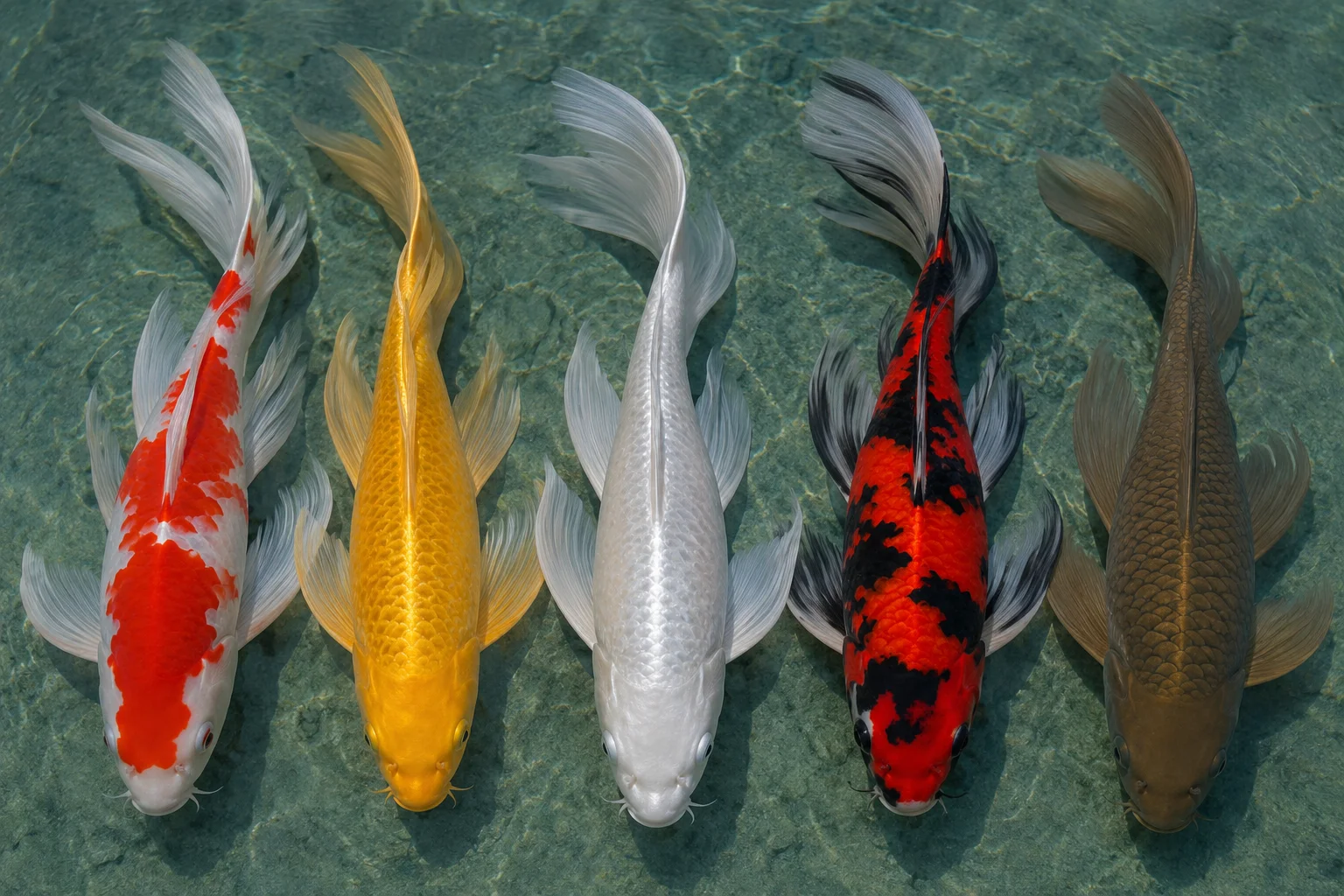
Butterfly koi are not a separate color classification — they are the longfin expression of any standard koi variety. Any koi color pattern can carry the butterfly fin gene. Here are the most popular butterfly koi varieties:
| Variety | Colors | Visual character | Popularity |
|---|---|---|---|
| Kohaku butterfly | White + red | Classic red and white with flowing fins; the most recognizable | ⭐⭐⭐⭐⭐ |
| Sanke butterfly | Red + white + black | Three-color drama amplified by flowing fins | ⭐⭐⭐⭐⭐ |
| Showa butterfly | Black + red + white | Bold black base; dramatic contrast; striking in motion | ⭐⭐⭐⭐⭐ |
| Yamabuki Ogon butterfly | Metallic gold | Solid gold with glittering metallic fins — stunning in sunlight | ⭐⭐⭐⭐⭐ |
| Platinum Ogon butterfly | Metallic white/silver | Pure silver with flowing white fins; ethereal, ghost-like | ⭐⭐⭐⭐⭐ |
| Chagoi butterfly | Brown / olive / bronze | Earthy tones with flowing fins; the friendliest butterfly koi | ⭐⭐⭐⭐ |
| Karashigoi butterfly | Yellow / mustard | Bright yellow with long fins; easy to spot in any pond | ⭐⭐⭐⭐ |
| Hi Utsuri butterfly | Black + red/orange | Bold black and red; dramatic and visually powerful | ⭐⭐⭐⭐ |
| Shiro Utsuri butterfly | Black + white | High contrast black and white; elegant and striking | ⭐⭐⭐ |
| Kujaku butterfly | Metallic + net pattern | Reticulated metallic pattern with peacock-like appearance | ⭐⭐⭐ |
| Hariwake butterfly | Gold + white (metallic) | Two-tone metallic; clean and bright in sunlight | ⭐⭐⭐ |
| Doitsu butterfly | Any color (scaleless) | Scaleless skin + long fins = maximum visual drama; very rare | ⭐⭐ (rare) |
How big do butterfly koi get? Size guide
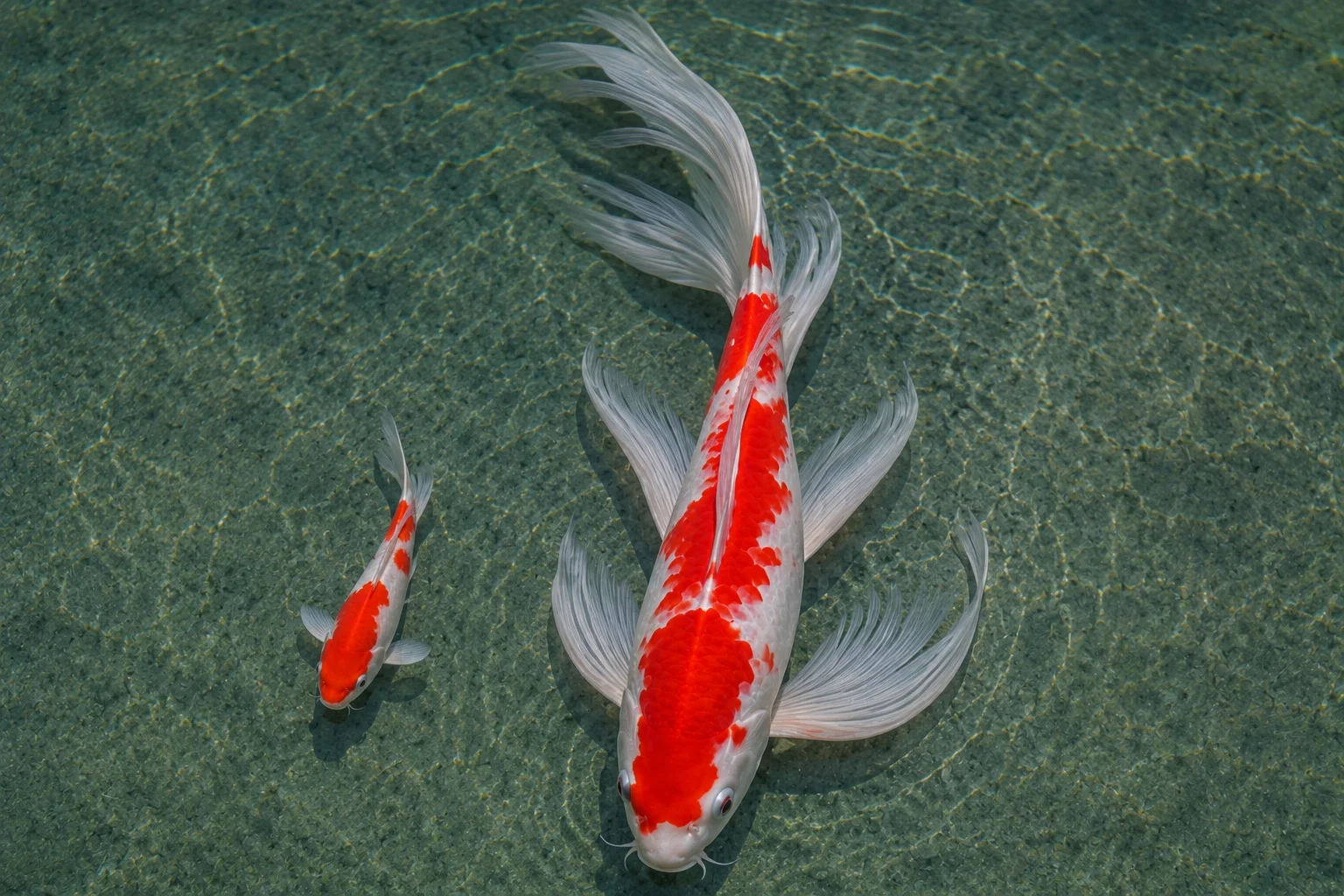
Butterfly koi grow to impressive sizes — comparable to standard koi in body length but appearing much larger due to their long fins. Their body is typically slightly slimmer than a standard koi of the same length.
| Age | Body length | Fin length (approx.) | Notes |
|---|---|---|---|
| 6 months (Tosai) | 4–8 inches (10–20 cm) | 1–2 inches | Fins just beginning to elongate; easily distinguished from standard koi |
| 1 year | 8–14 inches (20–35 cm) | 3–5 inches | Fins becoming noticeably long; barbels elongating |
| 2–3 years | 14–22 inches (35–55 cm) | 6–10 inches | Full butterfly character established; dramatic pond presence |
| 5 years | 22–30 inches (55–75 cm) | 12–18 inches | Fins up to 60% of body length; stunning in motion |
| 10+ years | 30–36+ inches (75–90+ cm) | 18–27+ inches | Fins can reach ¾ body length; maximum visual drama; some exceed 36 inches body |
Key size facts:
- Butterfly koi fins never stop growing as long as the fish is healthy and blood vessels supply the fin tips
- Their body is slightly more slender than standard koi — they appear long and elegant rather than deep-bodied
- Fins grow faster in warm water (above 68°F/20°C) during the active feeding season
- Fin growth slows significantly in cold water and stops almost entirely below 50°F (10°C)
- A high-protein diet during warm months maximizes both body and fin growth
How long do butterfly koi live? Lifespan guide
Butterfly koi live 25 to 35 years under optimal pond conditions — the same lifespan range as standard koi. Some koi researchers believe butterfly koi may actually live even longer than standard koi due to their closer genetic relationship with wild carp, which can live 40+ years in natural conditions.
| Factor | Effect on lifespan | Butterfly koi specific note |
|---|---|---|
| Water quality | Most important factor overall | Poor water causes fin rot — the #1 butterfly koi killer |
| Fin injuries | Can introduce fatal infections | Critical butterfly koi concern — sharp objects must be removed |
| Diet quality | Immune system and growth | High-protein diet supports fin regeneration after minor tears |
| Pond size | Space for natural behavior | Long fins need more turning radius — overcrowding causes fin damage |
| Predator stress | Chronic stress shortens life | Long fins make butterfly koi slightly more vulnerable to herons |
| Genetics / bloodline | Upper lifespan ceiling | Strong bloodline fish from reputable breeders live longest |
The practical lifespan summary: a butterfly koi in a well-maintained pond with zero fin injuries, good water quality, and proper nutrition will easily reach 25+ years. A butterfly koi in a pond with sharp rocks, poor water quality, and aggressive pond mates may struggle to reach 10 years — fin rot and infection are that significant.
Butterfly koi vs standard koi — key differences
| Feature | Butterfly koi | Standard koi |
|---|---|---|
| Fins | Dramatically elongated; grow continuously | Compact and proportional; fixed length |
| Body shape | Slightly slimmer, more streamlined | Deep-bodied, barrel-shaped |
| Swimming style | Slow, graceful, flowing | Active, faster, more energetic |
| Barbels (whiskers) | Long, can fork and elaborate | Short and simple |
| Show eligibility | Banned from Japanese/UK shows; AKCA standards in US | All major shows worldwide |
| Fin vulnerability | High — prone to tearing and fin rot | Low — short fins are more robust |
| Price | Slightly lower than equivalent standard koi | Higher at show level; similar at hobbyist level |
| Visual impact | More dramatic and ethereal | Bolder, more powerful color display |
| Pond aesthetic | Serene, meditative, elegant | Vibrant, active, dynamic |
Related: Butterfly koi vs regular koi — detailed comparison
Fin care — the most important butterfly koi consideration
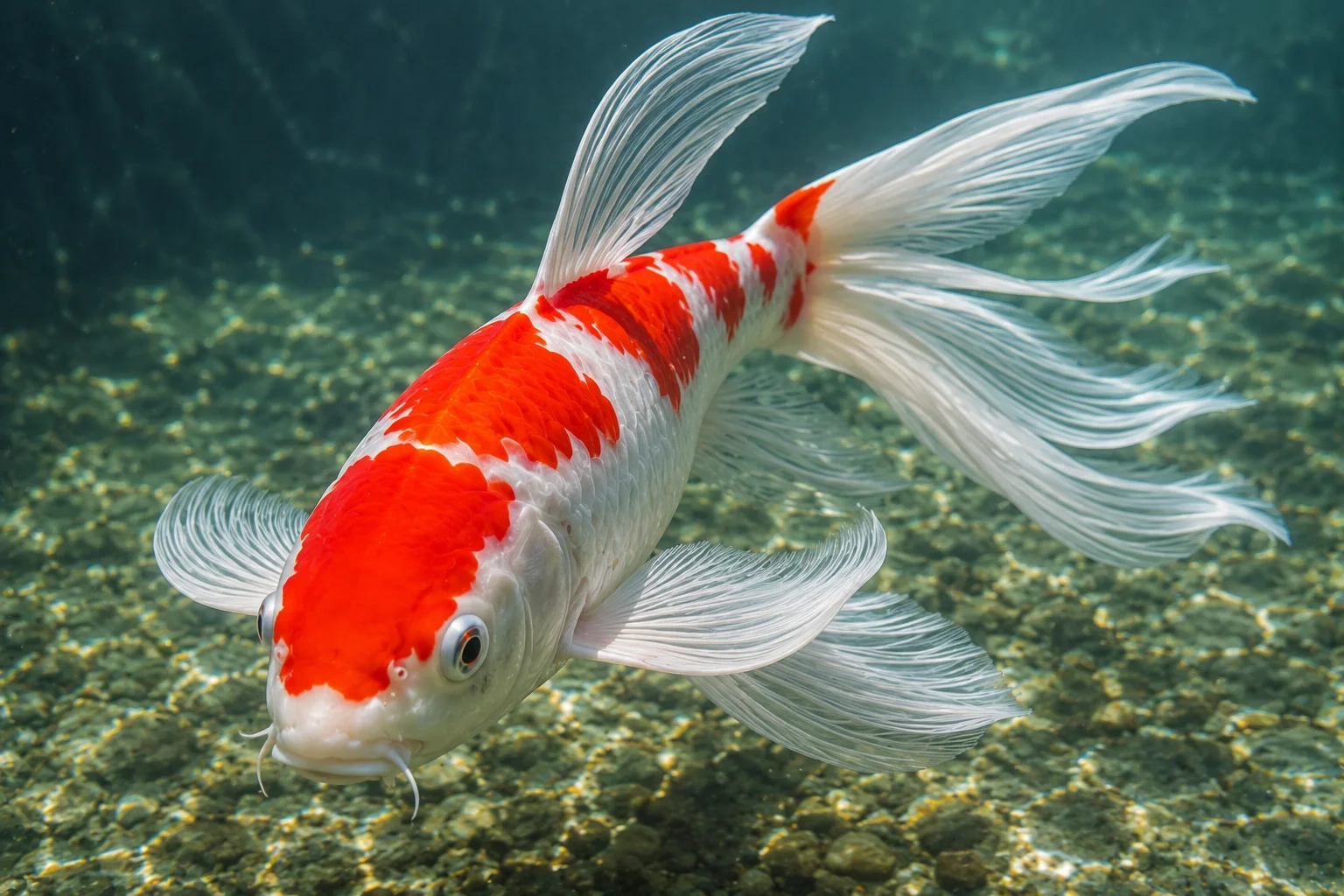
The long, flowing fins of butterfly koi are their greatest asset and their greatest vulnerability. Fin care is the single most important additional consideration for butterfly koi keepers — everything else is identical to standard koi care.
The three main fin threats
| Threat | Cause | Signs | Treatment |
|---|---|---|---|
| Fin rot | Bacterial infection from poor water quality; Aeromonas or Pseudomonas bacteria | White, ragged, or dissolving fin edges; fin appears to be melting from the tip inward | Immediate 30% water change; broad-spectrum antibacterial treatment; improve filtration |
| Physical tearing | Sharp rocks, rough pond liner edges, decorations, nets during handling | Clean tear or split in fin tissue; blood streaking along tear | Minor tears often self-heal in clean water; significant tears may need antiseptic treatment; always remove the sharp object |
| Fin nipping | Aggressive pond mates — goldfish, other koi, or even other butterfly koi competing for food | Irregular bites or chunks from fin edges; multiple small tears | Identify and separate the aggressor; ensure all fish are adequately fed at the same time; treat wounds with antiseptic |
Butterfly koi fin care checklist
- Remove all sharp objects from the pond — rocks with jagged edges, rough concrete corners, sharp decorations. Run your hand along all surfaces the fish might contact.
- Maintain excellent water quality — fin rot is almost entirely caused by poor water. 0 ppm ammonia and nitrite, pH 7.0–8.5, weekly water changes. Clean water = healthy fins.
- Inspect fins weekly — look for white edges (early fin rot), splits, tears, or blood streaking. Early detection is the difference between a minor treatment and a major infection.
- Be very careful with nets — butterfly koi fins tangle in nets catastrophically. Use a koi sock (soft mesh bag) for handling rather than a standard flat net wherever possible.
- Monitor feeding — butterfly koi swim more slowly than standard koi and may be outcompeted for food by faster tank mates. Feed from multiple points around the pond to ensure all fish eat adequately.
- Avoid strong currents — powerful pump returns or waterfalls creating strong current zones force butterfly koi to work hard against the flow, causing fin stress. Place returns to create circulation without strong directional current.
Early fin rot warning signs
Act immediately if you see: white or grey coloring appearing at fin edges; fins that appear to be getting shorter over days; ragged or frayed fin tips; blood streaking along the fin rays. Fin rot progresses fast in warm water. A 30% water change and antibacterial treatment started within 24 hours of first signs can save a fin. Delayed treatment can cost the fish the entire fin — or its life if bacteria reach the body.
Complete butterfly koi care guide
With the exception of fin care (covered above), butterfly koi have identical care requirements to standard koi. Here is the complete guide:
Pond size
Butterfly koi need more horizontal swimming space than standard koi of the same body length — their long fins require more turning radius. A minimum of 1,000 gallons (3,785 liters) for a small group, with the standard stocking rule of 10 gallons per inch of fish length applied to body length only (not including fins).
Pond design considerations specific to butterfly koi
- Smooth surfaces everywhere — liner, rocks, pipes, and equipment all must be smooth or padded
- Avoid strong current zones — butterfly fins create drag; powerful currents tire them and cause fin stress
- Wider pond = better — their long fins need turning space; a long, narrow pond is worse than a wide round one
- Minimum 3 ft depth — same as standard koi; deeper is better for temperature stability
Butterfly koi care parameters
| Parameter | Ideal range | Butterfly koi note |
|---|---|---|
| Pond size | 1,000+ gallons (3,785+ L) | Wider ponds preferred for fin turning space |
| Water temperature | 59°F–77°F (15°C–25°C) | Fins grow fastest in warm water above 68°F |
| pH | 7.0 – 8.5 | Poor pH = weakened immunity = fin rot risk |
| Ammonia (NH₃) | 0 ppm | Any ammonia accelerates fin rot in butterfly koi |
| Nitrite (NO₂) | 0 ppm | Same as standard koi |
| Nitrate (NO₃) | <40 ppm | Weekly 20–25% water changes |
| KH (alkalinity) | 100–200 ppm | Stabilizes pH; prevents crashes |
| Dissolved oxygen | >6 mg/L | Adequate aeration; avoid strong directed currents |
| Pond depth | Min. 3 ft (90 cm) | 4+ ft in freezing winter climates |
| Stocking density | 10 gal per inch of body length | Measure body only — do not include fin length in calculation |
| Compatible pond mates | Standard koi, goldfish (non-fin-nipping) | Monitor for fin nipping; separate aggressors immediately |
| Lifespan | 25–35 years (possibly longer) | Fin health is the key variable affecting lifespan |
Feeding butterfly koi
Butterfly koi have the same nutritional requirements as standard koi but one critical behavioral difference: they are slower feeders. Their long fins create drag that makes them slower than standard koi — which means in a mixed pond, faster standard koi may consistently outcompete them for food.
Feeding strategies for butterfly koi
- Feed from multiple points around the pond simultaneously — this prevents faster standard koi from monopolizing the food zone while butterfly koi approach more slowly
- Floating pellets are essential — surface feeding lets you observe which fish are eating and ensure butterfly koi are getting their share
- 5-minute rule — remove uneaten food after 5 minutes; this is especially important because uneaten food that butterfly koi miss will decompose and raise ammonia
- High-protein pellets in warm season — protein supports both body growth and fin growth and repair; use large-pellet formulas for adult butterfly koi
- Color-enhancing pellets with astaxanthin or spirulina maintain vibrant colors in all butterfly koi color varieties
| Water temperature | Food type | Frequency |
|---|---|---|
| Below 50°F (10°C) | Stop feeding | None |
| 50–60°F (10–15°C) | Wheat germ pellets only | Once daily, small amounts |
| 60–68°F (15–20°C) | Wheat germ + standard pellets | 2× daily |
| Above 68°F (20°C) | High-protein + color-enhancing pellets | 3–4× daily, 5-minute rule |
The show controversy — why butterfly koi are banned from Japanese shows
This is one of the most interesting aspects of butterfly koi that most care guides ignore — and it reveals a genuine philosophical divide in the koi world.
Butterfly koi are excluded from traditional Japanese Nishikigoi competitions by both the ZNA (Zen Nippon Airinkai — Japan’s primary koi show organization) and the UK Koi Judges Association. The reason is straightforward: traditional koi judging criteria were developed over decades specifically for the proportions, body shape, and fin structure of standard-fin Nishikigoi. These criteria simply do not apply to butterfly koi’s unique anatomy.
The philosophical dimension goes deeper. Japanese koi purists consider Nishikigoi a living art form with 200 years of carefully refined standards — the Gosanke varieties (Kohaku, Sanke, Showa) in particular represent the pinnacle of this tradition. Introducing a long-finned fish into that judging framework is seen as comparing apples to oranges, or more precisely, comparing a traditional Japanese painting to a different art form entirely.
The American response
The AKCA (Associated Koi Clubs of America) has developed specific judging standards for butterfly koi, and many American shows now include “Best Longfin” categories — typically divided into under 18 inches and over 18 inches. American koi culture has been far more receptive to butterfly koi than Japanese or British traditions, which is reflected in the enormous popularity of butterfly koi in the US market.
My view after 40+ years
The debate between “purists” and butterfly koi enthusiasts has always struck me as a false choice. Both are extraordinary fish. Standard Nishikigoi are about bold, vibrant color statements and the precision of pattern — judging them makes sense as a discipline. Butterfly koi are about movement, grace, and the mesmerizing quality of fins in water — that is a different aesthetic experience entirely, not an inferior one. A pond with both is richer for having both.
How much do butterfly koi cost?
| Grade | Price range | What you get |
|---|---|---|
| Pond / pet grade | $15–$60 | Mixed color patterns; good fins; healthy; ideal for beginners |
| Select grade | $60–$200 | Good color definition; well-developed fins; recognizable variety pattern |
| High grade | $200–$1,000 | Excellent color, pattern, and fin length; import quality; show-worthy in US standards |
| Premium metallic | $500–$3,000 | Yamabuki/Platinum Ogon with exceptional metallic sheen and fin quality |
| AKCA show grade | $1,000–$5,000+ | Competition quality for US butterfly koi shows; exceptional specimens |
Butterfly koi generally cost 10–30% less than equivalent standard koi because they are not recognized in Japanese show competition. This makes them excellent value — you get comparable visual impact and lifespan at a lower price point.
How to choose a quality butterfly koi
- Evaluate fin quality first: Fins should be symmetrical, fully intact, with no white edges, splits, or tears. The fins are the entire point — a butterfly koi with damaged fins is not worth purchasing regardless of body color.
- Check color definition: Apply the same standards as standard koi — clear demarcation lines, intense color, no bleeding or fading. For metallic varieties, look for consistent sheen from nose to tail.
- Assess body shape: Should be well-proportioned — not too thin or pinched. Slightly slimmer than standard koi is normal; emaciated or sunken belly is a health red flag.
- Observe barbel condition: Barbels should be intact and symmetrical. Damaged or missing barbels indicate rough handling or disease history.
- Watch it swim: Butterfly koi should swim with flowing, graceful movements. Clamped fins, erratic swimming, or listing to one side indicate illness.
- Inspect for parasites: Look for white spots (Ich), golden dust (velvet), or flashing behavior (scratching against objects) — all indicate parasites.
- Ask about the pond conditions: What temperature and water parameters was the fish kept in? A sudden parameter change during transport stresses butterfly koi significantly.
- Quarantine always: Butterfly koi fins make excellent parasite hiding spots. Quarantine new fish for minimum 3 weeks before adding to an established pond.
Frequently asked questions
What is a butterfly koi fish?
Butterfly koi (also called longfin koi or dragon koi) are ornamental koi with dramatically elongated, flowing fins that continue growing throughout their lives. They were created by crossing traditional Japanese Nishikigoi with long-finned wild carp from Indonesia, first produced in 1982. They come in all standard koi color patterns.
How big do butterfly koi get?
Butterfly koi body grows to 24–36 inches (60–90 cm), slightly slimmer than standard koi of the same length. Their fins can grow to three-quarters of their body length — so a 30-inch butterfly koi may trail fins of 20+ inches. Fins grow continuously throughout the fish’s life.
How long do butterfly koi live?
Butterfly koi live 25–35 years under optimal conditions — the same as standard koi. Some believe they may live even longer due to their wild carp genetics. Fin health is the key variable: fin rot and injuries are the primary causes of premature death in butterfly koi.
Are butterfly koi harder to care for?
Their water, diet, and pond requirements are identical to standard koi. The one additional consideration is fin care — removing sharp objects from the pond, maintaining excellent water quality to prevent fin rot, monitoring for fin nipping, and being careful when handling with nets.
What is the difference between butterfly koi and regular koi?
Fins and swimming style. Standard koi have compact fins; butterfly koi have dramatically elongated fins that grow continuously. Butterfly koi swim more slowly and gracefully. They are also banned from Japanese and UK koi shows but have US ACKA judging standards. Price-wise they are slightly less expensive than equivalent standard koi.
How do you treat fin rot in butterfly koi?
Act immediately: perform a 30% water change, add a broad-spectrum antibacterial treatment, and improve filtration. Fin rot is caused by bacterial infection from poor water quality — fixing the water is the cure, not just the medicine. Fins can regenerate if treated early enough. Advanced fin rot reaching the body can be fatal.
Why are butterfly koi called dragon koi?
Their long fins and barbels (whiskers) give them a resemblance to the dragons of East Asian mythology. “Dragon koi” and “dragon carp” are used interchangeably with butterfly koi in Asian markets. In Japan they are called Hirenaga (long fin) or Onagagoi (long tail carp).
How much do butterfly koi cost?
$15–$60 for pond-grade fish, $60–$200 for select grade, $200–$1,000 for high grade, and $1,000–$5,000+ for AKCA show-quality specimens. Butterfly koi cost 10–30% less than equivalent standard koi because they are not recognized in Japanese show competition.
Related koi variety guides
- Butterfly koi vs regular koi — detailed comparison guide
- White butterfly koi — elegance and symbolism guide
- Hi Utsuri butterfly koi — black and red variety guide
- 30 koi fish varieties — complete identification guide
- Chagoi koi — the friendliest koi variety
- Goshiki koi — the five-color variety guide
- Koi pond water quality guide — keeping your butterfly koi healthy
- Koi food guide — best feeds for growth and color
- Most expensive koi fish — prices and records
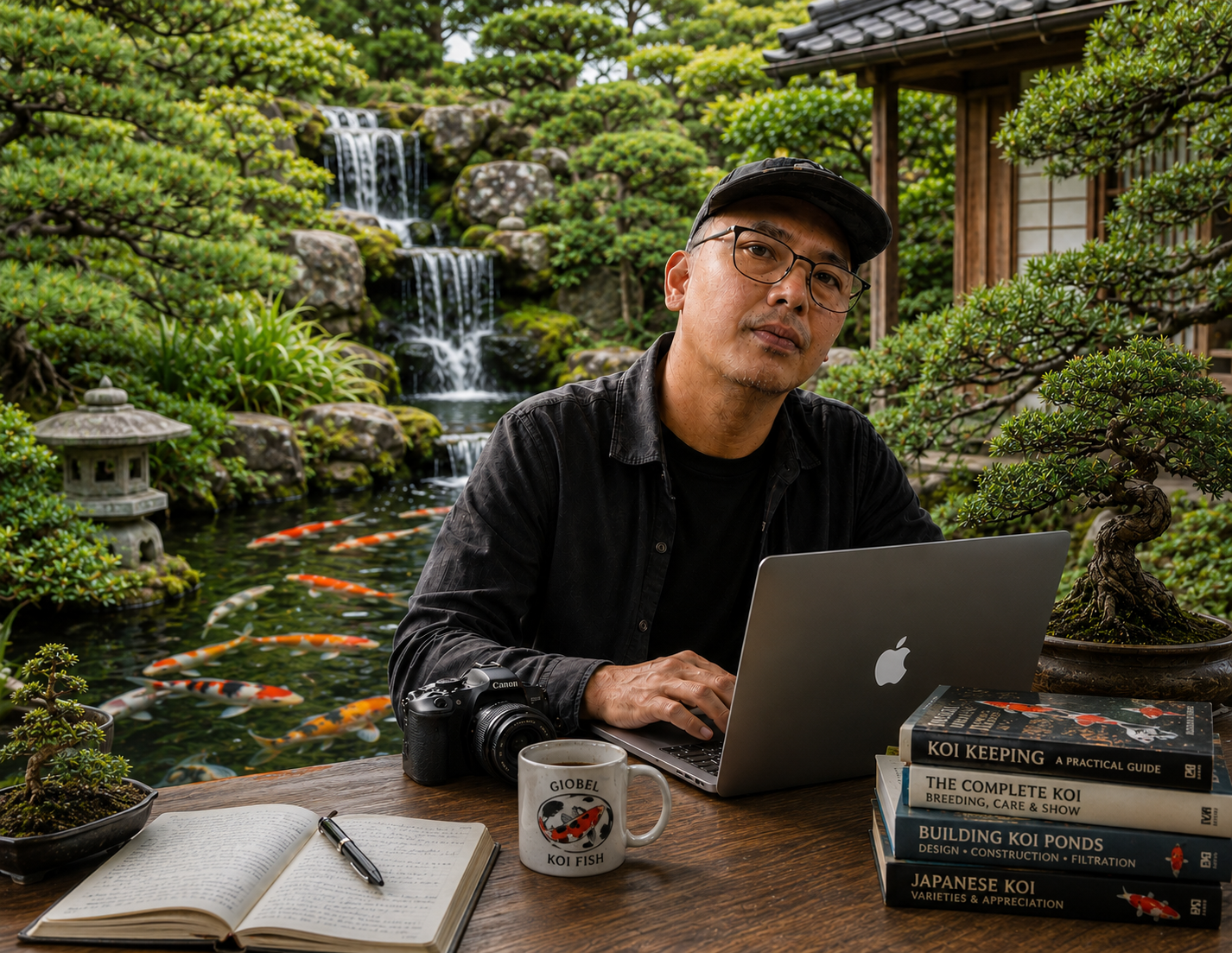
Giovanni Carlo Bagayas
Founder, Giobel Koi Center · Koi keeper since the 1980s · Labangan, Zamboanga del Sur, Philippines
Giovanni has been keeping and breeding ornamental koi since the 1980s, including butterfly koi since the 1990s when they first became available in the Philippines. His 40+ years of hands-on experience covers butterfly koi fin care, pond design, feeding strategies, and the philosophical debate around their place in koi culture.

Passionate about fish keeping since elementary school in the 1980s, Giovanni Carlo has dedicated countless hours to collecting and breeding a diverse array of ornamental freshwater fish. From vibrant guppies and majestic koi to striking bettas and classic goldfish, he continues to explore the fascinating world of aquatics, sharing knowledge and enthusiasm with fellow fish enthusiasts.